
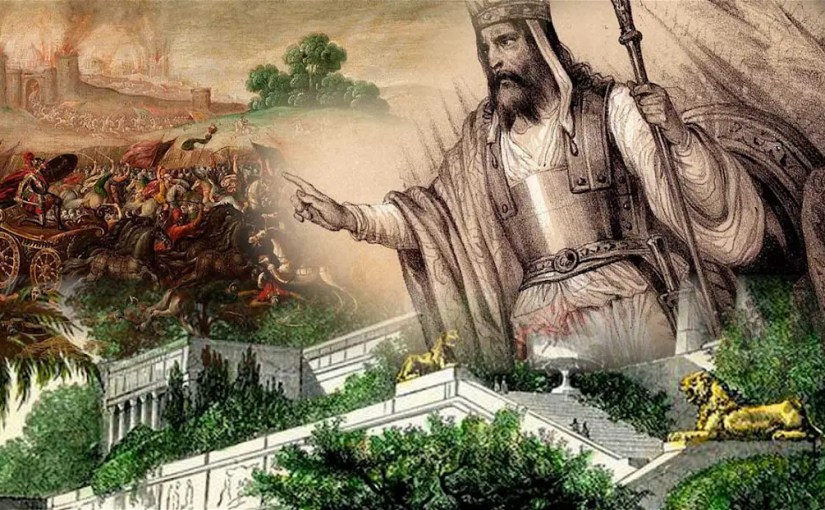
In my current studies of the Essenes, I found a striking similarity between the Josephus’ account of the Essenes regarding banishment of a member who has broken the rules of the community and is consigned to living in the desert and eating grass (or herbs), and the story of Nebuchadnezzar in the biblical book of Daniel. Both involve excommunication and the ‘eating of GRASS’.
I always wondered at this passage in the bible as eating grass and living like an animal sort-of sticks in one’s mental imagery! I find this too coincidental to be unrelated, which begs the question, were Daniel and his friends members of the most pious group of Jews, The Essenes? And did King Nebuchadnezzar become an initiate and member, who, when he became proud in himself as ruler of Babylon, was immediately banished by ‘them’ as an animal in the wild to eat grass for 7 ‘times’ before being restored to his kingdom???
I will include quotes for clarity:
Daniel Chapter 4: Nebuchadnezzar’s Humiliation (around 580 BC)
“All this came upon King Nebuchadnezzar. At the end of the TWELVE MONTHS as he was walking about the royal palace of Babylon. The king spoke, saying, “Is not this great Babylon, that I have built for a royal dwelling by my mighty power and for the honor of my majesty?”
While the word was still in the king’s mouth, a voice fell from heaven: “King Nebuchadnezzar, to you it is spoken: the kingdom has departed from you! And THEY shall drive you from men, and your dwelling shall be with the beasts of the field. THEY shall make you eat grass like oxen; and seven times shall pass over you, until you know that the Most High rules in the kingdom of men, and gives it to whomever He chooses.”
That very hour the word was fulfilled concerning Nebuchadnezzar; he was driven from men and ate grass like oxen; his body was wet with the dew of heaven till his hair had grown like eagles’ feathers and his nails like birds’ claws.
Nebuchadnezzar Praises God
And at the end of the time I, Nebuchadnezzar, lifted my eyes to heaven, and my understanding returned to me; and I blessed the Most High and praised and honored Him who lives forever:
For His dominion is an everlasting dominion,
And His kingdom is from generation to generation.
All the inhabitants of the earth are reputed as nothing;
He does according to His will in the army of heaven
And among the inhabitants of the earth.
No one can restrain His hand
Or say to Him, “What have You done?” [sounds like Job]
At the same time my reason returned to me, and for the glory of my kingdom, my honor and splendor returned to me. My counselors and nobles resorted to me, I was restored to my kingdom, and excellent majesty was added to me. Now I, Nebuchadnezzar, praise and extol and honor the King of heaven, all of whose works are truth, and His ways justice. And those who walk in pride He is able to put down.” ~Daniel 4:30-37
~~~~~~~~~~~~~~~~~~~~~~~~~~~~~~~~~~~~
The Essenes–the Holy Ones–the People of the Way
Josephus is an ancient Jewish historian and wrote a lot about a special branch of the Pharisees (a sect of Israelites) which we know of as the ‘Essenes’, the secret brotherhood to whom is attributed the hiding of the Dead Sea Scrolls so far discovered in 10 of 11 caves where they dwelt at Wadi Qumran. For the purpose of this post, I am just referring to how the Yahad (the elders) dealt with those members who were initiated into the secret society, but then faltered in its rules due to sin or disrespect.
Josephus relates via his book The Judean War (76AD) that if “anyone has sinned badly he is expelled from the society, though that person-bound by oaths and practices-can starve since he, ‘grass-eating’, cannot eat normal food, so that he is OFTEN TAKEN BACK IN THE END”. ~Joan Taylor, The Essenes, the Scrolls, and the Dead Sea (2014).
And Josephus via the Jewish Encyclopedia: Discipline of the Essene Order:
“They have no special city of their own, but live in large numbers in different cities, and if any of their followers comes from a strange city everything they have is considered as belonging equally to the newcomer; those who were never known before are received as kindred and friends.” [Hence, the great sin of Nebuchadnezzar saying the nation-state of Babylon was his, created by him for him versus belonging to God’s and God’s chosen people, even if in exile]
“If any of them be condemned for any transgression, he is expelled from the order, and at times such a one dies a terrible death, for inasmuch as he is bound by the oaths taken and by the rites adopted, he is no longer at liberty to partake of the food in use among others (([because he has spent at least a YEAR if not 3 YEARS becoming worthy and pure enough to partake of sacred meals together, the breaking of bread])) [Here Josephus: “and being compelled to eat herbs, he famishes his body until he perishes.”] Occasionally they pity those exposed to dissolution [“shammata”], considering punishment unto death sufficient. In their judicial decisions they are most accurate and just; they do not pass sentence unless in company with one hundred persons [this is possibly a combination of the higher court of seventy-two (“Sanhedrin gedolah”) and the smaller court of twenty-three (“Sanhedrin ḳeṭannah”)], and what has been decided by them is unalterable. After God they pay the highest homage to the legislator (that is to say, to the Law of Moses), and if any one is guilty of blasphemy against the Lawgiver, he is punished with death. They are taught to obey the rulers and elders [J: “the majority”]”.
~~~~~~~~~~~~~~~~~~~~~~~~~~~~~~~~~~~~~~~
My commentary:
Note how those who are banished in the above passages obey ‘THEM’, the order, as in the story of Daniel where it states ‘THEY’ banished the king. Who would the ‘they’ have been who banished King Nebuchadnezzar in Daniel when King Nebuchadnezzar should have been the most powerful entity in his own kingdom? Could this mean that Daniel and the secret order of Essenes, known by other names such as Sons of Zadok (referring to the priestly line of Aaron, Moses’ brother), were actually ruling Babylon behind the scenes, undoubtedly through a holy conversion that took place in the king after Daniel gave the king the proper interpretation of the king’s dream??? It is striking that part of the esoteric knowledge of the Essenes was the ability to prophesy accurately, which Josephus also writes about extensively in his works. The book of Daniel is full of prophecy and interpretations with which no kingdom magician is able to contend.
Interestingly, the Greek word for the name ‘Essene’ is derived from the same word being used as a designation of the priests of Artemis of Ephesus, who had to observe strict rules of purity for ONE YEAR, and Artemis has been posited to be an early reference to Mary, of Jesus fame. Later, in the Essene Community Rule scrolls dated to 160 BC they lay out a specified timeline for new initiates of 1 year, followed by 2 years, of probation to become part of the Yadad brotherhood at Qumran. This initiation of 3 years might not have been applied to all Essenes since there were Essenes scattered all over Judea and the Holy Land, including in Egypt and Babylon via the diaspora and captivity of the Hebrews. Perhaps the initiation for the ‘satellite’ Essenes, if you will, was only one year. Or perhaps they increased the initiation period from 1 to 3 years between the time of Babylonian captivity to the Qumran colonization.
There is so much depth in the book of Daniel. But just a superficial glance is enough to demonstrate that there are numerous similarities between Daniel; his friends; King Nebuchadnezzar’s conversion, humiliation, and repentance; and the Essenes.
Taken as a whole, it boggles my mind that there is the real possibility that underneath the surface of truth and life as told in the bible, there is a mystical, esoteric knowledge known only by those ‘with eyes to see and ears to hear’ that might extend back to oral Torah times (Adam or Noah’s days) and the Way may have been promulgated by the prophets (Daniel), prepared by John the Baptiser, and perfected by Jesus.
Thanks for reading! 
 ~Song of Mary~