
The Talpiot Tomb, the family tomb where Jesus’ body might have been laid to rest, invites the brave to consider the heavy concept of physical versus spiritual resurrection. Since the time of Christ, many of the most important bible stories in the New Testament are confined to a literal interpretation by elite theologians and simple pastors alike. This leads the listener down an obligatory dead-end alley of literal interpretation, with no room for discerning another possibility. But I say this needn’t be the case. That in careful interpretation–and introspection–the bible can actually be more aptly interpreted in these stories in a spiritual, versus physical, way.
In order to not become distracted here, I will stick to one story on my mind: the story of Jesus’ resurrection. This is not an exhaustive exegesis of this concept, but merely an opening of the door into this miraculous event and my argument that a spiritual interpretation is the only explanation that makes any sense.
I appreciate that the bible is an ancient document. I mean it was orally transmitted millenia ago, and the latest biblical tales all occurred by the end of the first century AD. So we are talking ancient ancient history. It is pretty hard for most of us to ponder what it must have been like to live over 2,000 years ago! And even if that is our personal jam, we still probably wouldn’t come too close to an accurate understanding because it’s just so long ago. I mean, germ theory, physics, and astronomy have all become so much better understood than in those times. Also, we have collective generations of people behind us who have relied upon the bible to make meaning of their lives, which has shaped us and our culture whether we realize it or not. So the way we think about things is very different than how they thought about things.
Ancient man was necessarily much more literal-minded than we need to be today. We understand that there are tiny machinations of things at work that the naked eye cannot see, but which cause real material changes to occur. In those days, if you couldn’t see it, it was all ascribed to the gods, or God. As Christians we know everything was made by God, but God uses the natural processes He made to cause events and effect change. God does this in a supernatural way we cannot understand as His ways are not our ways, but it filters down to us in a natural way, if we have eyes to see this.
Because ancient people lived in a more concrete way, from day to day, they needed to be shown the gospel in a way that they could understand. God doesn’t always want everyone to understand everything as evidenced in Jesus’ parables. Remember how his own disciples struggled to make meaning of similes and metaphors? But the thrust of the gospel–Jesus being raised on the 3rd day–was the keystone upon which Christianity was founded, and it was imperative that chosen ones got it so that they could then pass it along. If this concept was not grasped, Christianity would have slowly died out. God knew this, so in His genius, He provided for different interpretations to be available in the one bible for all men, for all time.
Some men and women are literal-minded, they need to perceive a truth in order to believe it. Others are more abstract-minded, they are able to understand the immaterial without difficulty. Because God makes both kinds of people, He provided that the bible also accommodated this reality.
In several places in the bible, namely Acts and 1st Corinthians, Paul says that Christ died, was buried, and on the third day was raised according to the scriptures. He goes on to say Christ was seen by hundreds of the brethren and apostles, and lastly by him. In Acts, Paul literally says he ‘saw’ Christ when he was still Saul, yet we know that he only had a vision of Christ, so he ‘saw’ and heard Christ in his mind’s eye as it were in a bright flash of Light; none of his other traveling companions saw or heard Christ speak though they did witness the bright Light. So as we can see, he uses the word ‘saw’ literally and figuratively, regardless of the circumstance. This is hard for us to understand because we use language differently. Paul also does this with the word ‘sleep’ for death of the brethren. Because Paul understands–and preaches–so intimately that believers do not die but pass into eternal life, he does not use the word death at all regarding believers who pass away, but the term ‘sleep’. We think of sleep as one thing usually: nighttime slumber or napping. I am convinced that Paul, through God’s inspiration, was taking liberty with words that men used in their daily lives to mean something literal and assigning to them a more abstract meaning. So that those with eyes to see and ears to hear could understand on a deeper or more spiritual level, as needed.
Paul had the difficult task of spreading the story of Christ’s crucifixion and resurrection to all men: those that needed to believe literally, and those that were able to understand deeper, less visible, truths while remaining true to the simple story of the gospel.
If you read the accounts Paul gives of Christ being resurrected from the dead, you can see that he never closes it off to having to be a physical, bodily resurrection! He always leaves an ‘out’ as it were for those who are able to understand that our bodies are spiritually resurrected into who we will be in heaven. Paul becomes ‘all things to all men’ when he teaches on this subject, which is the cornerstone of Christianity. Some men cannot believe unless they envision Jesus’ physical body floating into heaven in a supernatural event. But some (like me) cannot believe unless I imagine it as an invisible spiritual supernatural event. This is also the case for me regarding the ‘virgin’ birth where virgin had different meanings in those days. But I already posted about that.
I can imagine easily that Jesus’ spirit laid dormant 3 days then rose into Heaven to be with God, making a way for all of His chosen ones–those who believe in Him–to also make this journey in the blink of an eye when our bodies pass from life to death. Those 3 days must have been terrible! This would have been an invisible event to living creatures and seen only by heavenly beings. People who have had near-death experiences speak of signs of heaven and of hell. It baffles my mind that people, especially in our day, have a hard time believing something that they cannot see. For me, things unseen are truer than things seen!
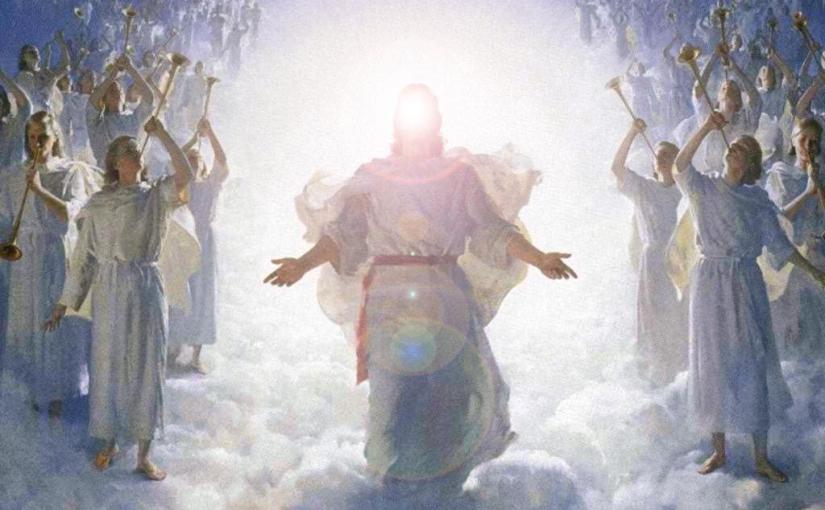
So when preachers and teachers become dogmatic that the bible must be interpreted only literally or only figuratively, they are both wrong. God allows for those with eyes to see and ears to hear the truth of how He works. Some people, because of the way they are made, cannot believe something unless it is presented to them in a concrete way; others are able to believe in a more abstract way. The point is that Jesus rose from the dead and sits at the right hand of God, and will return ‘in the clouds with honor and great glory’ to rule again.
It tickles the imagination to think of His spiritual return, what this will look like. He will be in His spiritual body. We don’t know what his physical body looked like or what his spiritual body will look like when He returns. But everyone will KNOW it is Him in that time. I can’t personally believe that a physical Jesus-esque body will float down to us from the sky…
But maybe something like a reverse black hole happens: a WHITE expanding cloud from the heavens envelop us, while His brighter blinding Light and His consciousness pervades our every cell so that all living creatures KNOW He is Jesus returning to rule and reign.






 ~Song of Mary~