Let God be Your Physician

Bless the Lord, O my soul;
And all that is within me, bless His holy name!
Bless the Lord, O my soul,
And forget not all His benefits:
Who forgives all your iniquities,
Who heals all your diseases,
Who redeems your life from destruction,
Who crowns you with lovingkindness and tender mercies,
Who satisfies your mouth with good things,
So that your youth is renewed like the eagle’s.  ~Psalm 103:1-5

There is much debate and conjecture among Christians (and Jews) about whether using physicians is God’s will for us.  It is true that many physicians are Christians, but that does not make it necessarily God’s will for us, any more than any profession or action done by a Christian makes it God’s will for us.  In the following passage, God is obviously very chagrined that King Asa, who reigned longer than either King David or King Solomon, sought care from physicians instead of the Lord; so much so that He allowed him to die from his affliction.

And in the thirty-ninth year of his reign, Asa became diseased in his feet, and his malady was very severe; yet in his disease he did not seek the Lord, but the physicians.  So Asa rested with his fathers; he died in the forty-first year of his reign.  ~2 Chronicles 16:12-13

Critics argue that this means you should also seek the care of God, not just physicians.  But this makes no practical or logical sense because doctors’ treatment is largely atheistic and lacks faith, whereas God’s method of healing is largely by faith, simple touch, and prayer.  These are diametrically opposed philosophies.  If you are seeking curative treatment with a surgeon’s scalpel how does faith in the Lord and prayer factor in?  If you are healed, the glory will go to the doctor and surgery you had, not to God.  The whole reason the healing of Naaman worked from the prophet Elisha was because it was so simple as to give God the glory!

God likes to work miracles in such a way as to bring people to faith in Him.  This cannot happen when you have two conflicting belief systems at work in you.  It is similar to how the ancient Israelites worshiped God but also held to belief in their idols, praying to them and making offerings to them to ‘cover all their bases’.  Does God like this?  No he does not.  He wants all the faith, all the belief, and all the glory to go to Him, being a jealous God for us.

Let’s face it:  those who seek out doctors for care don’t really believe God can or will heal them.  Most may say a token prayer, pray daily, or even add a loved on to the church prayer list for Sunday, but they save the heavy faith for their doctor and their hospital.  At the root of this is the fleshly fear that we might become sick or die.  Men and women may prolong their life with a heart bypass or their quality of life with man-made pharmaceuticals, but this is not God’s will.

Concomitantly, due to the following verse in the Bible by the Apostle Paul, many believe Luke the Evangelist to have been primarily a doctor:

Luke the beloved physician and Demas greet you.  ~Colossians 4:14

Paul may been using the word ‘physician’ liberally to mean simply healer or comforter since Luke was an intelligent man of faith and accompanied Saint Paul on many of his journeys.  We know Luke was definitely a good historian and even artist, but the only reference historically to him being a medical doctor was the above description used by Paul, which can mean many things, as illustrated by Jesus’ use of the term ‘physician’, and the use of the term in the Old Testament by the prophets.

In other words, Luke may have been more of a ‘faith healer’ than modern day physician.  So to use this one statement to support the claim that God allows Christians to seek out care from physicians is to negate all the Biblical evidence to the contrary!

There is only one word used for ‘physician’ in the Bible in each of the Biblical languages, Hebrew and Greek.  The New Testament Greek word for physician is iatros, which means physician.  The Old Testament Hebrew word for physician is R-PH-A or R-PH-H, raphah, which means to mend, to cure, and to slacken or cease.  In Strong’s Concordance these are the listed references to ‘physician’ and ‘physicians’:

New Testament:

Matthew 9:11-13:  And when the Pharisees saw it, they said to His disciples, “Why does your Teacher eat with tax collectors and sinners?  When Jesus heard that, He said to them, ‘Those who are well have no need of a physician, but those who are sick.  But go and learn what this means: ‘I desire mercy and not sacrifice.’  For I did not come to call the righteous, but sinners, to repentance.” [Jesus is stating that sickness is spiritual, and that He is a physician who can heal them]

Mark 2:17:  “When Jesus heard it, He said to them, ‘Those who are well have no need of a physician, but those who are sick. I did not come to call the righteous, but sinners, to repentance.'” [A repeat of the above verses]

Luke 4:23-27:  He said to them, ‘You will surely say this proverb to Me, ‘Physician, heal yourself! Whatever we have heard done in Capernaum, do also here in Your country.’” Then He said, ‘Assuredly, I say to you, no prophet is accepted in his own country.  But I tell you truly, many widows were in Israel in the days of Elijah, when the heaven was shut up three years and six months, and there was a great famine throughout all the land; but to none of them was Elijah sent except to Zarephath, in the region of Sidon, to a woman who was a widow.  And many lepers were in Israel in the time of Elisha the prophet, and none of them was cleansed except Naaman the Syrian.”  [It takes faith to be healed by God, and by the same token, God chooses whom He will and will not heal.  It is His sovereign right as God to have power over life and death.]

Luke 5:30-32:  And their scribes and the Pharisees complained against His disciples, saying, ‘Why do You eat and drink with tax collectors and sinners?’  Jesus answered and said to them, ‘Those who are well have no need of a physician, but those who are sick.  I have not come to call the righteous, but sinners, to repentance.’” [A repeat of the above verses in Matthew and Mark]

Colossians 4:14:   “Luke the beloved physician and Demas greet you.” [See above]

Mark 5:25-34:  A woman who had suffered a condition of hemorrhaging for twelve years—a long succession of physicians had treated her, and treated her badly, taking all her money and leaving her worse off than before—had heard about Jesus. She slipped in from behind and touched his robe. She was thinking to herself, “If I can put a finger on his robe, I can get well.” The moment she did it, the flow of blood dried up. She could feel the change and knew her plague was over and done with.  At the same moment, Jesus felt energy discharging from him. He turned around to the crowd and asked, “Who touched my robe?”  His disciples said, “What are you talking about? With this crowd pushing and jostling you, you’re asking, ‘Who touched me?’ Dozens have touched you!”  But he went on asking, looking around to see who had done it. The woman, knowing what had happened, knowing she was the one, stepped up in fear and trembling, knelt before him, and gave him the whole story.  Jesus said to her, “Daughter, you took a risk of faith, and now you’re healed and whole. Live well, live blessed! Be healed of your plague.” [ALL the physicians that tried to treat her failed her and treated her badly until she took an intuitive step of faith, reached out to Jesus, and was healed by Him.  Physicians today do the very same thing, pretend to be able to cure us, take our money, and often cause more harm than good, leaving us worse off than we were to begin with.]

Luke 8:43-48:  Now a woman, having a flow of blood for twelve years, who had spent all her livelihood on physicians and could not be healed by any, came from behind and touched the border of His garment. And immediately her flow of blood stopped.  And Jesus said, “Who touched Me?  When all denied it, Peter and those with him said, “Master, the multitudes throng and press You, and You say, ‘Who touched Me?’”  But Jesus said, “Somebody touched Me, for I perceived power going out from Me.” Now when the woman saw that she was not hidden, she came trembling; and falling down before Him, she declared to Him in the presence of all the people the reason she had touched Him and how she was healed immediately.  And He said to her, “Daughter, be of good cheer; your faith has made you well. Go in peace.” [A repeat of the above verse]

Old Testament:

Jeremiah 8:22:  “Is there no balm in Gilead; is there no physician there? why then is not the health of the daughter of my people recovered?” [Jeremiah mourns for the people here after the Lord has punished them for backsliding and holding fast to deceit without repenting of their wickedness.  Not even the balm of Gilead nor the physicians there can heal them once God has a mind to strike them down.]

Genesis 50:2:  When Jacob finished commanding his sons, he drew up his feet into the bed and breathed his last and was gathered to his people.  Then Joseph fell on his father’s face and wept over him and kissed him.  And Joseph commanded his servants the physicians to embalm his father. So the physicians embalmed Israel.  Forty days were required for it, for that is how many are required for embalming. And the Egyptians wept for him seventy days.” [The Egyptian physicians were Joseph’s servants, Joseph being a son of God.  He used them not to heal the living, but to embalm the dead, as per the custom in Egypt at that time.]

2 Chronicles 16:12 (quoted above)

Job 13:1-16:

“Behold, my eye has seen all this,
My ear has heard and understood it.
What you know, I also know;
I am not inferior to you.
But I would speak to the Almighty,
And I desire to reason with God.
But you forgers of lies,
You are all worthless physicians.
5 Oh, that you would be silent,
And it would be your wisdom!
Now hear my reasoning,
And heed the pleadings of my lips.
Will you speak wickedly for God,
And talk deceitfully for Him?
Will you show partiality for Him?
Will you contend for God?
Will it be well when He searches you out?
Or can you mock Him as one mocks a man?
10 He will surely rebuke you
If you secretly show partiality.
11 Will not His excellence make you afraid,
And the dread of Him fall upon you?
12 Your platitudes are proverbs of ashes,
Your defenses are defenses of clay.

13 “Hold your peace with me, and let me speak,
Then let come on me what may!
14 Why do I take my flesh in my teeth,
And put my life in my hands?
15 Though He slay me, yet will I trust Him.
Even so, I will defend my own ways before Him.
16 He also shall be my salvation,
For a hypocrite could not come before Him.” 

[Job criticizes his friends as liars and worthless physicians, and states that silence would be an improvement, giving wisdom (fear of the LORD) room to exist.  Even if He slay me, I will choose to trust the Lord.  Christians understand that death is not the end of the story, but only the beginning.  Those who seek out physicians are usually afraid of death, and put their trust not in God, but men who call themselves physicians.]


None of those references from the Bible speak very highly of physicians which is not surprising to true believers because physicians were analogous to Greek philosophers (whom Paul advocated against listening to) and likely progressed out of the magicians of Egypt and Babylon.

Looking deeper into the history and origin of medicine we find that it was the Egyptians and Babylonians that primarily perfected and used physicians, and later the Greeks and Romans.  Have these societies ever been the emulation of God’s chosen people?  A resounding, ‘No!’ would be the answer.  So why do we think it is okay to emulate it now?  Hippocrates, the ‘Father of Western Medicine’, lived from 460 to 370 bc, and created the Hippocratic Oath still in use for doctors today.  If medicine was such a reverent gift from God, it seems likely Jesus or the early church fathers would have spoken positively of it, and referred to it since it would have been well-known in their world by that time.  Yet they did not.  Paul, James, and Peter, the pillars of the early church, taught not to ‘make an appointment with a well-known physician to heal you’, but ‘to lay on anointed hands of those abiding in Christ, and pray’ for you.

Furthermore, the symbol used for medicine itself is the Rod of Asclepius, from Greek mythology.  Asclepius is a deity associated with healing and medicine.  It is a representation of a serpent entwined around a staff.  The serpent is God’s most cunning creature, cursed since the beginning of time for deceiving God’s chosen people.  The serpent conjures thoughts of gnosis, or knowledge, obtained illegally without God’s permission (Genesis 3).  And the staff represents God’s wand, used to perform miracles by His prophets, culminating in the sacrifice of the life of Jesus Christ, the Messiah.  To combine the staff with the serpent is heretical and blasphemous to the highest degree; it means replacing Jesus with the gnosis of man.

Which is really what we do when we seek out the care of a physician.

Why do we want to seek ‘healing’ from a profession that venerates and makes an idol of this creature which God cursed and replaces Jesus Christ as our physician?

Original Hippocratic Oath:

I swear by Apollo The Healer, by Asclepius, by Hygieia, by Panacea, and by all the Gods and Goddesses, making them my witnesses, that I will carry out, according to my ability and judgment, this oath and this indenture.

To hold my teacher in this art equal to my own parents; to make him partner in my livelihood; when he is in need of money to share mine with him; to consider his family as my own brothers, and to teach them this art, if they want to learn it, without fee or indenture; to impart precept, oral instruction, and all other instruction to my own sons, the sons of my teacher, and to indentured pupils who have taken the physician’s oath, but to nobody else.

I will use treatment to help the sick according to my ability and judgment, but never with a view to injury and wrong-doing. Neither will I administer a poison to anybody when asked to do so, nor will I suggest such a course. Similarly I will not give to a woman a pessary to cause abortion. But I will keep pure and holy both my life and my art. I will not use the knife, not even, verily, on sufferers from stone, but I will give place to such as are craftsmen therein.

Into whatsoever houses I enter, I will enter to help the sick, and I will abstain from all intentional wrong-doing and harm, especially from abusing the bodies of man or woman, bond or free. And whatsoever I shall see or hear in the course of my profession, as well as outside my profession in my intercourse with men, if it be what should not be published abroad, I will never divulge, holding such things to be holy secrets.

Now if I carry out this oath, and break it not, may I gain for ever reputation among all men for my life and for my art; but if I transgress it and forswear myself, may the opposite befall me.[5]

The beginning of this ancient oath starts out by honoring idols and end with glorifying oneself.  God as we know him is no where in this.  And it, or a version of it, is still used today by most medical schools in the United States.

 Instead, Christians should be true to God in everything, even if it means death.  Jesus taught us not to fear death, but to embrace it:
“Greater love has no one than this, that someone lay down his life for his friends.”  ~John 15:13
And that in seeking one’s life, he will lose it:
“Whoever seeks to preserve his life will lose it, but whoever loses his life will keep it.”  ~Luke 17:33
Finally, the very way we are to heal ourselves is given to us in God’s Word in the following passages:
~~~
“In that region there was an estate of the leading citizen of the island, whose name was Publius, who received us and entertained us courteously for three days. And it happened that the father of Publius lay sick of a fever and dysentery. Paul went in to him and prayed, and he laid his hands on him and healed him. So when this was done, the rest of those on the island who had diseases also came and were healed. They also honored us in many ways; and when we departed, they provided such things as were necessary.”  ~Acts 28:7-10
~~~
“Is anyone among you suffering? Let him pray. Is anyone cheerful? Let him sing psalms.  Is anyone among you sick? Let him call for the elders of the church, and let them pray over him, anointing him with oil in the name of the Lord.  And the prayer of faith will save the sick, and the Lord will raise him up. And if he has committed sins, he will be forgiven. Confess your trespasses to one another, and pray for one another, that you may be healed. The effective, fervent prayer of a righteous man avails much.”  ~James 5:13-16
 ~~~

Do not lay hands on anyone hastily, nor share in other people’s sins; keep yourself pure. No longer drink only water, but use a little wine for your stomach’s sake and your frequent infirmities.  Some men’s sins are clearly evident, preceding them to judgment, but those of some men follow later.  Likewise, the good works of some are clearly evident, and those that are otherwise cannot be hidden.”  ~1 Timothy 5:22-25

~~~

All we need is faith in Jesus to be well:

Who his own self bore our sins in his own body on the tree, that we, being dead to sins, should live to righteousness: by whose stripes you were healed.  ~1 Peter 2:24

If You Cannot Love Your Neighbor, You Cannot Love God

Matthew 22:36-40 New King James Version (NKJV)

36 “Teacher, which is the great commandment in the law?”

37 Jesus said to him, “‘You shall love the Lord your God with all your heart, with all your soul, and with all your mind.’ 38 This is the first and great commandment. 39 And the second is like it: ‘You shall love your neighbor as yourself.’ 40 On these two commandments hang all the Law and the Prophets.”

We are not loving God with all of our heart, soul, and might if we are not loving our neighbor as ourselves.  This is illustrated in this verse very well:

“Therefore, if you are offering your gift at the altar and there remember that your brother or sister has something against you, leave your gift there in front of the altar. First go and be reconciled to them; then come and offer your gift.”  ~Matthew 5:24-25

This is also supported by the old testament scripture that teaches us that obedience is better than sacrifice (1 Samuel 15:22), because we cannot sacrifice ourselves or an offering unto God knowing that we have not been obedient to his other great command to love our neighbor as we love ourselves.  God does not want us to come before him with false piety and righteousness when we have trespassed against or offended our neighbor.

Therefore if we cannot love our neighbor, we cannot love God.

~selah

Yom Kippur for Christians

Yom Kippur or The Day of Atonement is the holiest day of the year for the Jewish people.  Historically, it is the one day of the year the holy high priest could go behind the veil in the holy of holies and make atonement for the children of God before the mercy seat upon the ark of the covenant.  The biblical ceremony involved much cleansing, donning of sacred linen garments, sacrificing animals for their blood as a sin offering to the Lord, and finally releasing a scapegoat into the wilderness upon the head of which all the transgressions of the people had been laid by the priest from the previous year.

Since Jesus Christ was born and died, and since He is the perfect sacrificial lamb, He took our sins, past, present, and future upon Himself once and for all for those who accept and believe in Him.  As such, Christians’ tabernacle and holy of holies is our body with Him in residence.  And we may come before God at any time, not just one time per year!

It is still imperative that we observe this day as commanded by God in the Bible, and that we consider how blessed we are to have a savior make us holy for our Lord God!  Whereas the Jewish people believe the law is paramount the rest of the year, and only on one day are we redeemed, Christians believe faith in Christ is paramount every day, and the law is subjugate to that.

Every day for Christians should be the most holy day, because Jesus makes us new and redeems us every day.  We should be living in bliss compared to our Jewish brethren!

Thank you Lord God for sending your Son Jesus Christ to be our sacrificial lamb, and for shedding His blood to make atonement once and for all for us.

~Amen

Death and the Afterlife, Part III: Sheol

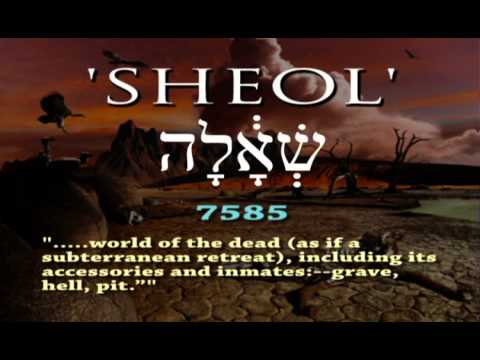
I emphatically believe there is an afterlife called Sheol.  Sheol is SHAL or SHAWL in Hebrew and means world of the dead.  It is pronounced sheh-ole’, with a long e.  Translators over the centuries have also called this hell.

The individual letters in the word Sheol tell us much about its meaning.  Hebrew is read from right to left.  The first letter of Sheol looks like a ‘W’ and is the letter ‘shin’, the 21st letter in the Hebrew alphabet.  It is next to the last letter in the alphabet with the last letter being T, Taw.  This itself means that Sheol is not the final place, but the next to last place.  If it were the final place, it would be better represented by T, as in Theol.

The legs of the shin converge downward into a central point or valley.  The Jews believe the way it is drawn represents the three valleys surrounding Jerusalem coming together with the central point being Jerusalem itself.  Note that Ezekiel below speaks about the bones of the valley coming to life.  Sheol is a pit.  Pit correlates with valley.  Overall the first letter of Sheol reminds us of the wide path to hell:

“Enter by the narrow gate; for the gate is wide, and the way is broad that leads to destruction, and many are those who enter by it.” (Matthew 7:13)

Then there is the letter A, aleph and looks kind of like our ‘X’.  A is undeniably the letter which represents God and things or people denoting God’s realm.  ALHYM is God’s name given to us in the first sentence of the Bible.  Coming after shin in the word Sheol shows us that God is the only one who can reach down into Sheol, but that He is right there beside those who suffer in Sheol, that they are not forgotten by Him.

The next letter in the word Sheol is an L, lamed, and it reaches up into Heaven!  The letter L is associated with words describing holy concepts in the Bible.  It is next to aleph because it is connected to Heaven.  Almighty ALHYM  contacted those in the pit, redeemed them, and sent them on into Heaven.

Sometimes a ‘vav’ or w (in modern Hebrew it is a v) is inserted between the aleph and lamed (A and L) in the word Sheol.  A vav serves as a divine connector or force of God that binds Heaven and earth (hebrew4christians.com).  In the picture of the word Sheol above, there is no vav.  However, in the above word for Sheol there is an H, hey, placed at the end.  H represents God’s breath and exists in everything.  At the beginning of words it imparts definition to a thing, or acknowledges something as it is.  In the middle of words it means God breathes right into the thing.  At the end of words it means femininity.  Being placed here at the end of Sheol it likely means He resurrected his bride from Sheol, and sent her into Heaven upon His breath.

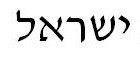
Finally, the letters in the word Sheol are strikingly close to the letters in the word for Israel:  YSRAL, showing us that God’s people are never far from Sheol, and as Jesus says, most will end up there.

ysrael (3)

~~~~~~~

As I have been describing in my vision given to me by God, Sheol for those who have denied God is a torment.  Here are some verses that offer some interesting descriptions of it:

The poor man died and was carried by the angels to Abraham’s side. The rich man also died and was buried, and in Hades, being in torment, he lifted up his eyes and saw Abraham far off and Lazarus at his side.  And he called out, ‘Father Abraham, have mercy on me, and send Lazarus to dip the end of his finger in water and cool my tongue, for I am in anguish in this flame.’ 25 But Abraham said, ‘Child, remember that you in your lifetime received your good things, and Lazarus in like manner bad things; but now he is comforted here, and you are in anguish. 26 And besides all this, between us and you a great chasm has been fixed, in order that those who would pass from here to you may not be able, and none may cross from there to us.’27 And he said, ‘Then I beg you, father, to send him to my father’s house—28 for I have five brothers—so that he may warn them, lest they also come into this place of torment.’ 29 But Abraham said, ‘They have Moses and the Prophets; let them hear them.’ 30 And he said, ‘No, father Abraham, but if someone goes to them from the dead, they will repent.’ 31 He said to him, ‘If they do not hear Moses and the Prophets, neither will they be convinced if someone should rise from the dead.’”  ~Luke 16:22-31

God allowed the rich man to look up into paradise to see the rich man being comforted by Abraham.  God is watching to see what the rich man says and what is in his heart when he is called to look up out of Hades (Sheol).  The rich man cared more about his brothers in this parable than himself, which is good.  When he asks if someone can go to them from the dead it is an allusion to Christ’s coming crucifixion and sacrifice on the cross, and his resurrection from the dead.  But to communicate with the dead is a sin, illustrated by the story of Saul and the witch of Endor, so there is no way Father Abraham will grant the rich man’s wish.

Once you die, it is too late to be redeemed except by the grace of God, and the prayers of those who breathe the Holy Spirit your direction.

…For there is no work or thought or knowledge or wisdom in Sheol, to which you are going.  (Ecc 9:10)

In Hebrew:

Work is ‘M’SaH’ and means activity or work.

Thought is ‘CHSHBWN’ and means contrivance, intelligence, or reason.

Knowledge is ‘D’TH’ and means knowledge, norantly, and cunning.

Wisdom is ‘CHKMah’ and means wisdom in a good sense, wisely.

Especially enlightening is the word for knowledge, D’TH, because this is the word referenced in the Bible for God’s knowledge, not just human knowledge.  The root word is YD’ which means ‘to know’.  There are other less divine words available to express human knowledge.

This shows us that Sheol is a place where they cannot work, they cannot reason, they cannot have knowledge, and they cannot be wise.

Many verses go on to speak about the lack of hope in Sheol or the Pit.  This excerpt is from Isaiah 38:17-18:

“…but You loved my soul from the pit of destruction; You have cast all my sins behind Your back.  For Sheol cannot thank You; death cannot praise You; the ones going down to the Pit cannot HOPE for Your truth.”

In these verses, the first mention of ‘pit’ is SHCHTH meaning corruption, grave, or pit.  Sheol means world of the dead or hell.  And the second mention of ‘Pit’ is BWR meaning bore, pit hole, dungeon.  Hope is SHBR meaning watching, or to expect.

Numerous verses speak to God retrieving those in Sheol, and there being a consciousness of sorts there:

“If I go up to heaven, You are there; if I make my bed in Sheol, You are there.”  ~Psalm 139:8

“Sheol and Abaddon lie open before the LORD; how much more the hearts of the children of man!”  ~Proverbs 15:11

“Though they dig into Sheol, From there will My hand take them; And though they ascend to heaven, From there will I bring them down.”  ~Amos 9:2

God is there with those in Sheol.  There is no memory, no knowledge, no intelligence, no activity, no wisdom, and no hope.  Man will suffer but not even understand why he is suffering.  All things that man needs to live as a man in God’s image and thrive are absent there.  Man in this state is completely at God’s mercy to reach out to him, because in Sheol it seems man will not be able to reach out and seek God anymore.  And I believe God has so much grace that it is right in line with His way to give man a final chance to turn his heart to God in Sheol.  While others sleep peacefully awaiting the Messiah, souls in torment are being saved in ways only God knows.

Only the most evil or wicked will be left in the Final Day, and cast into the eternal Lake of Fire.

The following vision from Ezekiel teaches us how we can each, through the Holy Spirit, reach our hearts down into Sheol and save those destined there for final destruction, helping them on into Heaven with our love through Jesus Christ.  God clearly iterates in this narrative that He gives us the power to do that!

Praise You Yahweh ALHYM for giving Your people a final, extra chance at everlasting life.

The Dry Bones Live

37 The hand of the Lord came upon me and brought me out in the Spirit of theLord, and set me down in the midst of the valley; and it was full of bones.Then He caused me to pass by them all around, and behold, there were very many in the open valley; and indeed they were very dry. And He said to me, “Son of man, can these bones live?”

So I answered, “O Lord God, You know.”

Again He said to me, “Prophesy to these bones, and say to them, ‘O dry bones, hear the word of the Lord! Thus says the Lord God to these bones: “Surely I will cause breath to enter into you, and you shall live. I will put sinews on you and bring flesh upon you, cover you with skin and put breath in you; and you shall live. Then you shall know that I am the Lord.”’”

So I prophesied as I was commanded; and as I prophesied, there was a noise, and suddenly a rattling; and the bones came together, bone to bone. Indeed, as I looked, the sinews and the flesh came upon them, and the skin covered them over; but there was no breath in them.

Also He said to me, “Prophesy to the breath, prophesy, son of man, and say to the breath, ‘Thus says the Lord God: “Come from the four winds, O breath, and breathe on these slain, that they may live.”’” 10 So I prophesied as He commanded me, and breath came into them, and they lived, and stood upon their feet, an exceedingly great army.

11 Then He said to me, “Son of man, these bones are the whole house of Israel. They indeed say, ‘Our bones are dry, our hope is lost, and we ourselves are cut off!’ 12 Therefore prophesy and say to them, ‘Thus says the Lord God: “Behold, O My people, I will open your graves and cause you to come up from your graves, and bring you into the land of Israel. 13 Then you shall know that I amthe Lord, when I have opened your graves, O My people, and brought you up from your graves. 14 I will put My Spirit in you, and you shall live, and I will place you in your own land. Then you shall know that I, the Lord, have spokenit and performed it,” says the Lord.’”

Jews Request a Sign, and Greeks Seek after Wisdom~

For Jews request a sign, and Greeks seek after wisdom, therefore Christ crucified is to the Jews a stumbling block and to the Greeks foolishness, but to those who are called, Christ is the power and wisdom of God.  Because the foolishness of God is wiser than men, and the weakness of God is stronger than men.  ~1 Corinthians 1:22-25

Gabriel’s Revelation

Gabriel’s Revelation, also called Hazon Gabriel (the Vision of Gabriel)[1] or the Jeselsohn Stone,[2] is a three-foot-tall (one metre) stone tablet with 87 lines of Hebrew text written in ink, containing a collection of short prophecies written in the first person and dated to the late 1st century BCE.[3][4] One of the stories allegedly tells of a man who was killed by the Romans and resurrected in three days. It is a tablet described as a “Dead Sea scroll in stone” ~Wiki

I believe Jesus Christ lived with the Essenes at Qumran for at least a while.  I believe it is where He predominantly learned, and came into His divinity.  Just because the concept of a suffering Messiah was around just before the time of His birth does not mean His life was any less divine.  The proof was in the pudding, and Jesus essentially said that Himself.  Told from birth He was the likely Messiah, and knowing the concept of a suffering Messiah still meant that He had to grow and learn, perform miracles, heal, be perfect, and come into His divinity as God willed that process to occur, and in God’s time, finally culminating in His crucifixion, resurrection, and ascension at the age of ~33.

https://archive.org/details/Aabbey1-IsraelKnohlMessiahsAndResurrectionInTheGabrielRevelation484

The Holy Trinity

It takes obedience to the Law and the Prophets,

Along with grace through faith in Jesus Christ,

To bring us unto God; to know His Divine Will and Living Word.

~~~~~~~

Paul argues that being obedient to the Law is not the means to salvation, but that is is faith through Jesus Christ that brings justification unto God.  He points out that otherwise, works would be enough for salvation, and that since all men are sinners, no matter how obedient to the Law we are, we will always fall short of attaining God’s Realm.  He quotes scripture in Genesis relating how,

“He [Abram] believed in the LORD, and He accounted it to him for righteousness.”  ~Genesis 15:6

This is true, indeed.  It takes faith and belief in God, and His Only Begotten Son, Jesus Christ, as our Lord Messiah to attain true everlasting salvation.

But scripture also says eleven chapters later that the LORD appeared to Isaac and blessed him by restating the covenant that He had made with his father, Abraham:

“…I will give to your descendants all these lands; and in your seed all the nations of the earth shall be blessed; because Abraham obeyed My voice and kept My charge, My commandments, My statutes, and My laws.”  ~Genesis 26:4-5

This shows that it is not just due to faith and belief that we, and our descendants, are blessed by God, but that it is very much due to obedience that we, and our descendants, are blessed by God on earth.

This raises the question as to whether faith in Jesus Christ provides us with eternal life, and obedience to God provides with abundant blessings while we live out our earthly lives.  Indeed, the Old Testament did not speak to heaven, though it did speak about having plenty for our generation, and the generations to follow, if we loved God, obeyed Him, and had faith in Him.

Some Christians seem more concerned with attaining salvation in Heaven, while flouting God’s Law here on earth.  What does this mean?

I think it is obvious that both a grounding and foundation in God’s Law and commandments, along with  faith and belief that Jesus Christ is our Lord Messiah, which enables us to have flourishing lives here, and in the afterlife, are important.  Why, as God’s Chosen Ones, have we argued the importance of one over the other for millenia?

I personally want to please God, love Him, and know Him more than anything.  In practicing this, I want to know His ancient Law, as well as live by the example His Son gave.  I am saved forevermore by faith in Jesus’ sacrifice to me on the cross, but I am also living a righteous life under God’s Law, and will be blessed by Adonai Elohim for doing so.

I do not desire to forego either one of these.  Do you?

Jewish-Christian versus Pagan-Christian

I recently bought a copy of Cradle of Christianity, published by the Israel Museum in Jerusalem.  It is an exhibition of artifacts from the time of Christ, in and around the time when the new religion of Christianity was dawning.  In it, they discuss how early Christians who believed in Jewish rites and Law were called Judeo-Christians, members of the “church from the circumcision”, and those who had no connection with Judaism were called members of the “church from the Gentiles”.

Initially, the majority of the members of the new faith in Palestine were Judeo-Christians, who believed (in opposition to Paul) that affiliation with the Jewish religion and observance of the commandments were prerequisites for Christian faith….In hellenized cities, of course, uncircumcised Christians formed the majority.  ~Cradle of Christianity p. 32

It occurred to me that if I am a Jewish-Christian, then my contemporary Christian brethren who do not believe in the Law, but only the concept of Jesus, should then be called Pagan-Christians, as their doctrine originally extends from the foundation of the Gentiles, who largely practiced pagan worship and were considered pagans.  The term for bypassing the foundation of our religion is “antinomian”, meaning in the Greek, anti law [nomos].  The earliest leaders put forth antinomian law at the Jerusalem Council when they voted that gentile Christians did not need to adhere to the Mosaic Law, only the Noahide Law, which basically means instead of following all God’s commandments, they were allowed to bypass them and follow a watered-down version for the new religion of Christianity [see more about this in my pending post on antinomianism and legalism].  If you think about it, the Roman influence is strong in modern Christianity, and Roman ways were gentile, or pagan, ways.  Much of how Christians express their Christianity is tied to pagan practices, even if the worshiper is unaware of this, down to the times of year and religious celebrations.

I think we should all just be called Christians, but for me being a Christian means adhering to God in all the ways he commands us in the Torah.  This means loving Him and listening to His Living Word and Holy Spirit every day.  It requires obeying His Law given to us by His Prophets.  And it means having faith in Him and loving our neighbor as ourselves, as Jesus taught, and honoring Jesus’ role as the everlasting sacrificial lamb of God.

Being a Christian is not just about holding dear the concept of Jesus, no matter how much I aspire to be like Jesus on a daily basis.  Being Christian is holding dear our Hebrew roots, no matter what our ethnicity is, because all who are born again unto God are His Children and His Chosen Ones.  We cannot ignore our foundation and the patriarchs of our religion.  We must pay them homage by daily meditation and recitation and prayer and obedience, to all God’s Laws, statutes, and commandments as He demanded from the very beginning.

The Holy Trinity~

to Love God

to Obey His Law

to have Faith in Him through Jesus Christ

“For if you carefully keep all these commandments which I command you to do–to love the Lord your God, to walk in all His ways, and to hold fast to Him—  then the Lord will drive out all these nations from before you, and you will dispossess greater and mightier nations than yourselves.”  ~Deuteronomy 11:22-23

“For the LORD’S…

“For the LORD’S portion is His people; Jacob is the place of His inheritance.” ~Deuteronomy 32:9