Part III: Jeremiah’s Hidden Prophecy

Originally posted on October 11, 2013

In Part I and II we explored how God does not want people to know His secrets to life, because He knows man will then want to control life, and controlling life is strictly God’s domain.

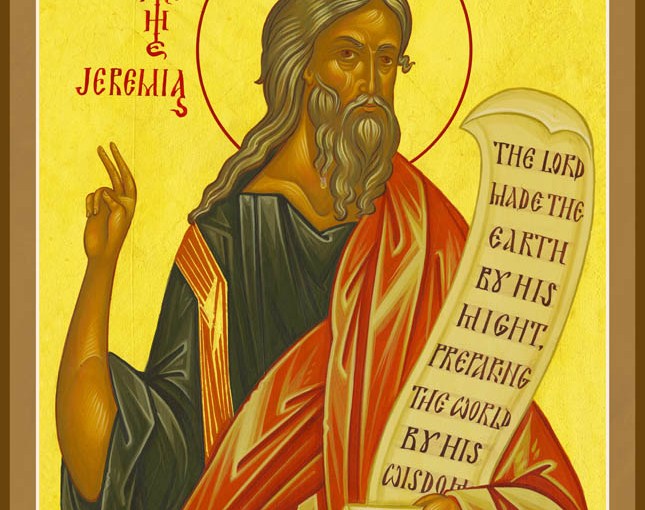
Jeremiah was a Prophet who lived from 655 to 586 BC.  He prophesied about the impending disaster to Jerusalem by the Babylonians because of the Hebrew people’s widespread idolatry.  But there is an interesting verse embedded in the Book of Jeremiah at 31:35-37:

“Thus says the LORD,

‘Who gives the sun for a light by day,

And the ordinances of the moon and the stars for a light by night,

Who disturbs the sea,

And its waves roar (The LORD of hosts is His name):

If those ordinances depart

From before Me, says the LORD,

Then the seed of Israel [God] shall also cease

From being a nation before Me forever.’”

“Thus says the LORD:

‘If heaven above can be measured, 

And the foundations of the earth searched out beneath,

I will also cast off all the seed of Israel [God]

For all that they have done,’ says the LORD.”  

I believe this is an ominous hidden message to us across the pages of time.  Of course, when it was read before our time period, one would take it to mean, ‘Well, that could never happen, so God is saying He will never cast us away.”  But now we know this can eventually happen as we pursue science and technology to explore the origins of the universe.  We also can search out the earth beneath, though possibly not with total accuracy yet.

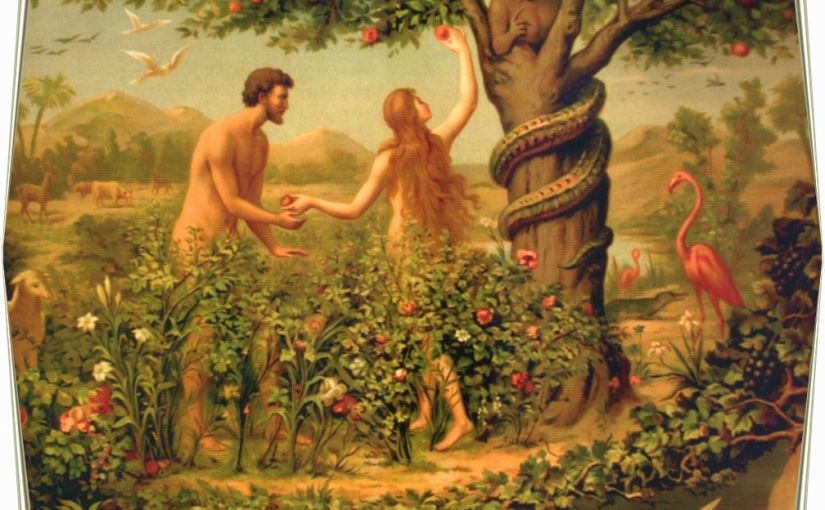
God is saying, “I will cast you off this earth for what you have done, if you try to seek My knowledge.”  Just like He cast out Adam and Eve from the Garden of Eden, and reinforced man’s separation from Him, God will not allow His creations to supersede Him.  He will prevail over man.

I don’t think He even likes us to TRY to find out His knowledge or secrets of the universe.  We have more important things to do, like learning how to grow food, and utilize our limited resources in a burgeoning, hungry world, than to try to attain God’s knowledge and power.


Who is correct, Nietzsche or Schopenhauer?  The urge to control life and live forever is, according to God, the inevitable goal of man once he attains God’s knowledge.  However, that urge is rooted in power.  Power is the conduit to wanting to be in control of everlasting life.  So, I’d say these ideals go hand in hand.  Both men are ‘right’ philosophically.  Sadly, in the end they were both wrong because they omitted the most important truth in their philosophy, which is God and His Truth; the only Truth there is.

Part II: The Will to Life Led to the Fall of Man

Originally posted on October 10, 2013

God was angry that His beloved, unique friends whom He had created to be with Him defied Him.  All they had to do was what God had commanded, and not eat of that one tree, and they would have lived happily ever after.  Since they didn’t, God punished them:

To Woman:  ‘I will greatly multiply you sorrow and your conception; in pain you shall bring forth children; your desire shall be for your husband, and he shall rule over you.’

To Man:  ‘Cursed is the ground for your sake; in toil you shall eat of it all the days of your life.  Both thorns and thistles it shall bring forth for you, and you shall eat the herb of the field.  In the sweat of your face you shall eat bread till you return to the ground, for out of it you were taken; for dust you are, and to dust you shall return.’  ~Genesis 3:16-19

He still lovingly made tunics for them and clothed them.  But since they had eaten of the tree of knowledge, God said,

“Behold, the man has become like one of Us, to know good and evil.  And now, lest he put out his hand and take also of the tree of life, and eat, and live forever”therefore the LORD God sent him out of the garden of Eden, and He placed placed cherubim and a flaming sword to guard the way to the tree of life.  ~Genesis 3:22-24

Notice how He didn’t tell them not to eat of the tree of life to begin with.  He knew that they would not have the power over life, which was uniquely His, unless they first tried to usurp His power.

God has secrets only He can know.  He created us, He gave us everything we need to live and flourish and be happy.  He only asks one thing:  for us to mind His commandments.  I’d say the primary commandment based on this story is:

DO NOT SEEK THE KNOWLEDGE OF GOD

For if man seeks the knowledge of God, he might eventually find it.  And therein lies the Power of Life.  God will NOT ever share this power with anyone.  When you try to seek His knowledge you make war with Him.  And He makes that clear.  Not just in Genesis and in Revelation, the first and last books of the Bible, but there is also an ominous threat from God to men seeking knowledge in the Prophet Jeremiah’s words…

Part I: The Will to Power Led to the Temptation of Man

Originally posted on October 10, 2013

Nietzsche argues with Schopenhauer that the highest drive of man is his strive for power.  Schopenhauer argues that Will to Life is the primary goal of man.

In this post, and the following one, I will explore that the drive of man for power led to God kicking him out of paradise.

In Genesis Chapter 2, God commanded the man, saying:

“Of every tree of the garden you may freely eat; but of the tree of the knowledge of good and evil, you shall not eat, for in the day that you eat of it you shall surely die.”  ~Genesis 2:16-17

Knowledge equals power.  Enter evil as serpent:

And the woman said to the serpent, “We may eat the fruit of the trees of the garden; but of the fruit of the tree which is in the midst of the garden, God has said, ‘You shall not eat it, nor shall you touch it, lest you die.’”  And the serpent said to the woman, “You will not surely die.  For God knows that in the day you eat of it your eyes will be opened, and you will be like God, knowing good and evil.”  So when the woman saw that the tree was good for food, that is was pleasant to the eyes, and a tree desirable to make one wise, she took of its fruit and ate.  She also gave to her husband with her, and he ate.  Then the eyes of both of them were opened, and they knew that they were naked….”  ~Genesis 3:2-7

They wanted the power that God had.  Simple as that.  They had everything they needed, they had Paradise!  But it wasn’t enough.  They wanted more.  They wanted to be like God.  And it seemed like there would be no ill consequence, besides God’s warning, it all seemed good.  As Neitzsche so aptly points out, “My idea is that every specific body strives to become master over all space and to extend its force and to thrust back all that resists its extension. But it continually encounters similar efforts on the part of other bodies and ends by coming to an arrangement (“union”) with those of them that are sufficiently related to it: thus they then conspire together for power. And the process goes on.”

Let us also remember that Satan got kicked out of Heaven for this same exercise:

“And war broke out in heaven: Michael and his angels fought with the dragon; and the dragon and his angels fought, but they did not prevail, nor was a place found for them in heaven any longer.  So the great dragon was cast out, that serpent of old, called the Devil and Satan, who deceives the whole world; he was cast to the earth, and his angels were cast out with him.”  ~Revelation 12:7-9

So the Enemy was, and is, perpetually looking for women and men who will collude with him to usurp God’s power, in a seemingly neverending process between good and evil.

In the next post, we will see how God responds…

The Bronze Age Dates the Torah

Originally posted on October 8, 2013

Moses lived between 1391 BC and 1271 BC.  These were pre-literate times in the Hebrew culture, so the story of Moses was passed along orally, in the form of the Oral Torah (Torah means ‘instruction’ or ‘teaching’) until it was finally transcribed.  It is postulated by scholars that the Oral Torah still continued to be told among families and tribes for a long time thereafter since literacy was not a reality for most ancient people.  The Oral Torah began to be written down around 1000 BC and was finalized somewhere around 587 BC, when the Hebrews underwent the second exile of their people, to Babylon under King Nebuchadnezzar.

Scholars state that the Moses Story contained in the Torah is remarkably pure even though hundreds of years exist between their inception and their transcription.  Somewhere around 1300 BC, Moses assumed leadership of the people and led them out of Egypt, and out of Pharaoh’s grasp, led them into the Wilderness, and delivered them, forty years later, to the door of the Promise Land.  Since the writings were not finalized until somewhere around 600 BC, that means that the oral tradition held fast for approximately 700 years!

One piece of evidence attesting to the purity of this epic tale resides in the fact that every object that God called Moses to assemble for the Tabernacle as soon as they entered the Wilderness was naturally occurring, with the exception of bronze.

“Then the LORD spoke to Moses, saying:  

‘Speak to the children of Israel, that they bring Me an offering.  From everyone who gives it willingly with his heart you shall take My offering.  And this is the offering which you shall take from them:  gold, silver, and bronze; blue and purple and scarlet yarn, fine linen thread, and goats’ hair; rams’ skins dyed red, badger skins, and acacia wood; oil for the light, and spices for the anointing oil and for the sweet incense; onyx stones, and stones to be set in the ephod and in the breastplate.  

And let them make Me a sanctuary, that I may dwell among them.’”  ~Exodus 25:1-8

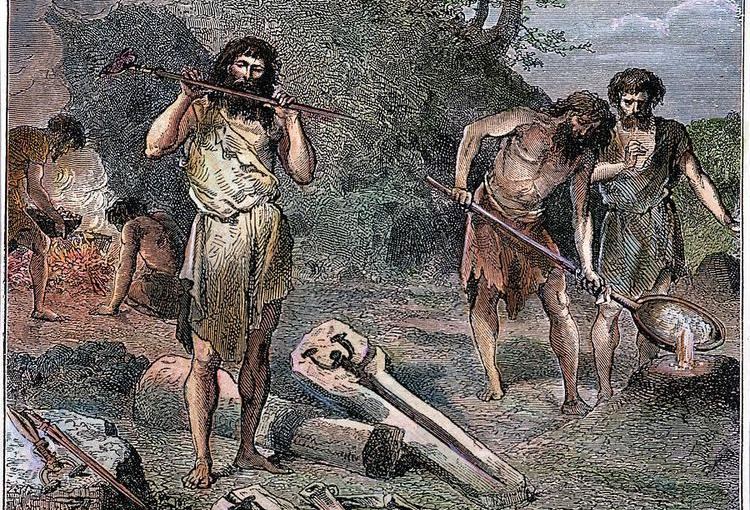
However, bronze was easily and simply made by primitive cultures by melting copper and tin together, and pouring it into molds to make a cast.  The Bronze age collapsed in the Near East around 1100 BC, so that by the time the Torah was written down 500 years later, the Iron Age was widespread and had been flourishing likely since 1000 BC, with wrought iron having been used since at least 1200 BC in that region, meaning iron had been a commonly used metal among the Canaanites for at least 400 years, probably longer.

This lends much authenticity to the purity of the early Old Testament; and validation for Moses being the rightful author of the Torah.  If the Torah had been tampered with later, when it was written down, it is very likely iron would have played a more prominent role in the story of ancient Hebrews.

God is Jealous for Woman~

Originally posted on October 7, 2013

God has given woman the special ability to have the blood of life flow through her body.  God loves woman and looks upon her with specialness and favor because He knows she alone can carry and bear life unto earth, graced by Him.

God knows how lustful and greedy men can be, so he put it in Moses’ heart to write the Law (without really understanding it fully) in such a way as that woman will be set apart every month, in such a way as to make men avoid her.  This provides woman a space from man and his lustly pursuits of her so that she might devote unrestrained attention to her LORD God, as He desires, having a special fondness for the female.  Moses used ‘impure’ to describe her during this time:  ”If a woman has a discharge of blood, she shall be set apart seven days during her impurity, and if any man lies with her, he shall be unclean.”  ~Leviticus 15:19,24  This negative view of her monthly cycle is no surprise since women were rather oppressed and without many rights in ancient times.

I know God looks upon women as the holy beings He made us to be, giving us the ability to bleed to bring forth new life, as a constant renewal of man, because the life is in the blood, and it is the blood that makes atonement for one’s life.  ~Leviticus 17:11 

He is so jealous for us, He has provided a way to get us all to Himself once a month.

You think of everything My Mighty Master~

Love,

~Mary

The Veil, Mended

Originally posted on September 11, 2013

Recently, a very astute and learned fellow and I discussed the bible, and I mentioned that I felt confession to a priest was one thing I think the Catholic church got right (along with some sacraments and rituals), but he countered with the popular protestant belief that when Christ died the veil was torn, making priests no longer a necessary bridge between God and man.  That simply having the concept of Jesus in one’s heart and mind was enough to make one holy in God’s eyes.  Current Christians, protestants and Catholics alike, have adopted the notion that there are two tiers:  God and man.  Priests have been relegated to ceremonial status, or are respected as teachers; but are not really considered to be any more holy than any other man.

However, there is a hierarchy of holiness, if you will, that does exist.  As one transcends the ladder unto Heaven where God resides, he becomes more holy.  As he becomes more holy, he obtains more Godliness.  The highest man can go would be to be like Jesus, which is the goal of all good Christians.  As one obtains more Godliness he also obtains more power, by the grace of God, in the forms of omnipotence, omniscience, and omnibenevolence.  The primary purpose of a priest’s life is to serve the LORD.  But priests also have the ability to minister to man on God’s behalf.  Jesus gave priests the power in God’s name to go forth and forgive sins, exemplified at the last supper, especially in John 20:21-23:

So Jesus said to them again, “Peace to you! As the Father has sent Me, I also send you.”And when He had said this, He breathed on them, and said to them, “Receive the Holy Spirit.  If you forgive the sins of any, they are forgiven them; if you retain the sins of any, they are retained.”

So for man to think that it is enough to think he is sorry for a sin, or to feel sorry for a sin, and that Jesus’ perfect death erases any need for a priest, is not scriptural and is not serving him fully; he is not going to reap the reward that true repentance and confession and forgiveness from a priest would allow.

I found a Catholic commentary on this subject and wanted to share it as it describes the benefits of confessing to a priest:

“The Advantages [of Confessing to a Priest]~

Is the Catholic who confesses his sins to a priest any better off than the non-Catholic who confesses directly to God? Yes.

First, he seeks forgiveness the way Christ intended.

Second, by confessing to a priest, the Catholic learns a lesson in humility, which is avoided when one confesses only through private prayer.

Third, the Catholic receives sacramental graces the non-Catholic doesn’t get; through the sacrament of penance, sins are forgiven and graces are obtained.

Fourth, the Catholic is assured that his sins are forgiven; he does not have to rely on a subjective “feeling.”

Lastly, the Catholic can also obtain sound advice on avoiding sin in the future.

During his lifetime Christ sent out his followers to do his work. Just before he left this world, he gave the apostles special authority [The last supper washing of feet of the apostles and eating of the body and blood of Christ illustrates the ceremony of the consecration of priests in the Old Testament Torah] commissioning them to make God’s forgiveness present to all people, and the whole Christian world accepted this, until just a few centuries ago. If there is an “invention” here, it is not the sacrament of penance, but the notion that the sacramental forgiveness of sins is not to be found in the Bible or in early Christian history.”  ~Taken from http://www.catholic.com/tracts/the-forgiveness-of-sins

I’d like to add that Jesus himself stated he did not come to abolish the law, but to fulfill it.  He made a new covenant, yes, but he replaced the need for daily animal sacrifice, and instead of priests taking on the people’s iniquity, he took it on himself.  The sacraments set forth by Moses were not abrogated by these things.

~Mary

Legalism versus Conceptualism

Originally posted on September 1, 2013

The way we believe as Christians currently is very conceptualistic, especially compared to the legalism of orthodox Judaism, as manifested in Jesus’ day, and before.  The Old Testament Torah is rife with hundreds upon hundreds of commandments, statutes, ordinances, and judgments that the children of Israel had to follow according to Moses, and those who put the oral tradition to paper, beginning in King David’s time.

Every day, Priests of the house of Aaron, of the house of Levi, had to offer, morning and evening, a fresh, clean, animal for sacrifice to atone for the people’s sins.  Not only could the common folk not come before the LORD, they could not even come near the tabernacle of meeting except to make their sin and peace offerings and tithes to the Priests and the Priests helpers.  And even Aaron and his sons and descendants could only go behind the veil to minister before the mercy seat–the actual presence of God–once per year, on the Day of Atonement.

It was necessary for the Messiah to come and to deliver man out of that impossible state.  Not only was it a blood bath daily, but the judgments handed out, even by Moses, were cruel, reminiscent of Hammurabi’s “eye for an eye, tooth for a tooth” law, carved into a code for the masses hundreds of years before.

So when Jesus came, and was accepted (eventually) as the perfect propitiation for our sins, and the sins of the whole world forever, what a relief it must have been!!  As the perfect Lamb of God, it became no longer necessary to sacrifice innocent animals daily to make man worthy.  Man was still unworthy, but Jesus made man new if man would only accept that Jesus was taking the place of the sacrificial beasts, and taking sin upon himself by dying willingly.

Jesus also preached a fresh message about God’s Love.  God in the OT was harsh and a discerning taskmaster more than he was a loving forgiver.  Oh, yes, he forgave the Hebrews much grumblings and times when they fell away from Him in the Wilderness, but God was definitely a harsh Elohim who could and would punish those for even questioning His rule; and He did it time and time again, as illustrated in the Old Testament.

It wasn’t that God became loving after Jesus, it is that when man first came to be monotheistic, it was in an atmosphere of polytheism where kings had godly attributes and could strike anyone down for anything; it was a harsh environment in which man lived.  So, the early tradition of the patriarchs saw God as the the One True God and divine, but in a way that replaced the all powerful impulsive pagan gods, but still held the basic aire of awesomeness and fearfulness that man had regarding his god; a primitive superstition that it is hard for us to understand across the deserts of time.  They were truly God-fearing.

Not many today would say they were God-fearing.  We have watered God down so that He is not so miraculous and wonderful as he was in the ancient times of our religion.  Men attributed almost everything to God’s signs and wonders in the early days of our faith, which is evident in the mythical stories of the Bible.  But now we place God somewhere in the middle of that great continuum and give him attribution and glory when WE feel it’s due; He doesn’t smite people anymore, He doesn’t have the ability (according to many) to heal miraculously anymore, He just sort-of hangs out loving us and watching us go about our way, without intervening in too fearful or too wonderful a way.

What happened to evoke this change in our outlook about God?  The are many reasons, but for now I want to focus on this part of it:  I think it was in large part due to our taking God out of our daily reality and putting him out of graspable bounds, into an abstract world we rarely have to contemplate.  The Hebrews had their tabernacle set in the midst of them.  Their whole world revolved around worshiping God daily through the Priests, making offerings of restitution and peace to the Priests, confessing to the Priests, and asking the Priests for atonement with God and judgments for conflicts in daily life.  Via blood sacrifice of animals and laws they could not overlook, like never eating blood, because the blood of an animal was too sacred for man to eat; and never eating fat because the fat was a sweet offering for the LORD; and laws like these, it was hard for man to escape his responsibility to God, and his role as congregant.

When Jesus came on the scene, he unbloodied the atonement ritual, which needed to happen.  Blood sacrifice smacked of pagan roots, though it was a necessary bridge for man being humbled before the LORD because the life is in the blood.  Ancient man revered this right of ceremony, and needed that to make atonement for their souls.  But Jesus did not erase all the Law, as much as he refined it.

Later, men came to start regarding Jesus as God, and this was a cemented decree at the Council of Nicaea in AD 325.  If Jesus replaces God, then it follows that everything Jesus said could replace everything in the Old Testament.  There is no surprise then that Christians rely too heavily on the New Testament, leaving the wisdom of the Old Testament to the dust of the ages.  Many Christians today cite the Two Great Commandments as the only ones needing to be followed.  They ignore the hundreds of other laws in the OT that God said, “This will be a statute for future generations, forever”!, and they allow any common folk to come directly before the LORD, no matter what sins they may have committed or whether they have sought proper restitution and forgiveness with a holy Priest.  Unless they are Catholic, they don’t even confess their sins anymore, and it’s doubtful most Catholics even still do attend confession.

They took liberties with Christ’s mission, and made Christ a thought and an action in place of God, whereby all that is required now in the eyes of most Christian doctrine is that one believes in Christ as Messiah and falsely, Christ as God, and all will be well with that person spiritually.  That one simply understands the concept of Christ for their life, and it will all be made right.

For nearly two millenium we have had man believing in the One True God.  Man was God-fearing and God, through Moses, made a lot of laws (some not from Moses) to keep man obedient.  Now for nearly two millenium we have man believing that the One True God is divided into three pieces and that just understanding that concept is enough to be obedient, that God is Loving.

The fact is that there is One True God.  He is to be feared and to be as friend.  He has laid out many laws for us to follow in every realm of our lives–spiritual, personal, familial, relational, financial, and societal, which can keep us obedient and successful.  We need those laws to be tangible and in our daily lives just as we need to understand they are sometimes intangible.  Jesus is not the answer.  God is the answer!  Jesus is a new bridge to God.  We cannot replace God with Jesus.  We cannot replace Priests with people.  We cannot replace daily worship to God merely with mindfulness of Jesus.

It takes love for God, faith (holding fast to Him at all times), and obedience (to walk in His ways), to come into the realm of God.  That is the holy trinity.

Love,

~Mary

The Problem of the 300 Levites

Originally posted on August 26, 2013

It’s funny how once you see it, it seems obvious, but before you see it, it isn’t.

That is the case with the 300 missing Levites.  Oh, yes, the Priestly Writer strikes again.  I’m having so much fun with him!  *squeals gleefully*   He gives me many good riddles to solve.  This one has me stumped however.  Now that I know his-’eh hum’-number, I can usually crack his codes quite quickly.  But the Case of the Missing Numbers in Numbers has me masticating.

Shall we begin?  This will be quite a whirlwind~

It starts at the beginning of the Book of Numbers with the census.  The numbers are important to me inasmuch as the Priestly Circle has hidden a code in them.  Other scholars have proven that the large swaths of people (hundreds of thousands) could not really have occurred during this time in the Wilderness, and have made legitimate arguments for that.  Since I know the Priestly Writer used numerology to make the numbers add up to a hidden cohesive code, I do not bother with trying to support or refute the likelihood of the actual numbers given in the Bible, but prefer to deduce the symbolic meaning they represent.

In the Wilderness, the tribes moved around the desert in a formation of a cross (E/S/W/N), in three tiers basically, with the precious Ark of the Covenant nestled in the very middle of them.  As this process is explained, it becomes clear, if one plots it, that the Priestly Circle attributes the most important people (for his purposes) to the East.  Then the South.  Then the West,  Then the North.  This makes a clockwise motion.  It’s not that the East is always the most important in the Bible.  Indeed the Ark of the Covenant within the Holiest of Holies is situated in a westerly direction.  But East has always been prized by ancient, pagan cultures, probably because the sun rises in the east.

Anyway, for brevity I will omit the actual families’ names here, but the book explains how the twelve tribes of Jacob are divided up into bands of three with the Levites in the middle, guarding the ark.  That equals 13, yes.  But remember that the tribe of Joseph was divided into two bands.  [the stage of this division is set up all the way back in Genesis in the poem, “Jacob’s Last Words to His Sons”, and is iterated more clearly in Numbers 1:32-35.  This makes me think the Priestly Writer’s influence was cast all the way back into Genesis].  If we crunch the numbers, we see that we come up with 10/10/10/7.  If we multiply these out we get 7,000.

Then the band of Levites is counted and their number given is 22,000 [Numbers 3:39].  However, if you add up the numbers given in “Census of the Levites Commanded”, one gets 22,300.  Did the Priestly Writer do this on purpose?  I’ve never noticed a ‘mistake’ in his numbers thus far.  It has been proposed that the numbers given for the family of Kohath (the most important family) of 8,600 has been mistransliterated from 8,300.  But if that is the case, then the larger band of Dan, et al., who serves the northern flank would also have been mistransliterated because their number given is 157,600.  I understand mistransliterations do happen as in the Red Sea really being the ‘Reed’ Sea, but when it comes to the Priestly Writer one just never knows!

So, that is the problem of the 300.  Let’s forge on.

The inner band of Levites is actually divided into two bands, their families from one month old and up; and those who service the articles of the tabernacle who are 30 to 50 years of age, make up the innermost circle, and even camp as a legion close to the articles.  When we apply numerology to the family band, we get the number 7.  When we apply it to the very inner priestly circle (!) we get 3.

The same clockwise rotation applies for the two circles of Levites as applied to the outer circle.  So, in effect, we get this:

  • outer circle:     1/7,000
  • middle circle:  7/22,000
  • inner circle:     12/3

Again, 22/7 represents a pi of 3.  But instead of a circle this time, we have three circles twirling together, as in a vortex.  1 and 7 and 12 represent 1 God, 7th degree of holiness, represented by 12 units within a circle (like a clock is divided into 12 hours).

So perhaps the Priestly Writer gave us an extra 300 because he wanted it to come out with 7 in the middle circle, and/or perhaps he wanted to repeat the theme of pi in a three-dimensional plane.  I doubt it was a mistransliteration…

Exciting times ahead, because as I was studying my spiritual journal I stumbed across a writing in Job and guess what a quick and simple addition revealed??  You got it: 22/7/3 again.  Scholars do not know who wrote Job, but I have a feeling I do.  And now you do as well.  🙂

This has rocked my world a bit, this numerology discovery.  At first I literally thought it was God speaking to me from His Word.  While I still think there was that aspect for sure, because I otherwise would never have seen it, A theory is working itself out in my head that in the era just before Christ came on the scene, there was so much debauchery and corruption within the Israelite ruling class, with firstborn sons having priestly privileges, and oftentimes abusing those privileges, not to mention bad rulers; that I think there existed an underground circle of priests who, throughout all these hard times of unGodly leadership and exile, tried to lace God’s true Word with a hidden meaning in order to identify it and keep it pure, for those deemed worthy.

I studied somewhat about the rulers in the first and second centuries B.C., and I see no evidence of these Priestly Circle numbers in their realm, though they did use numbers like 8 or 800, which was likely borrowed from a more eastern influence.  This sort-of thing can tell us, in light of the Priestly Writer’s hidden number code, that they probably were not deemed worthy nor were they truly holy high priests, even if they called themselves such.

In essence, the Priestly Writer might have manipulated the numbers and circumstances of the Old Testament to fit an agenda of who the Priestly Circle deemed worthy or important, versus it being the literal word of God, but that doesn’t mean that the primary import or meaning behind it is not Godly.  It does become obvious, however, that following certain, or ALL, of the recorded statutes word for word, is no different than following man-made law word for word.  As Jesus came to represent so well, God’s Word and Will stands deeper and is more unconditional than what men have had the ability to influence in the pages of time.

Update: Then I just ran across this link: https://www.thetorah.com/article/recounting-the-census-a-military-force-of-5500

Love,

~Mary

Is it God or is it Hammurabi?

Originally posted on August 22, 2013


The Old Testament Law concerning violence:

“But if any lasting harm follows, then you shall give life for life, eye for eye, tooth for tooth, hand for hand, foot for foot, burn for burn, wound for wound, stripe for stripe.”  ~Exodus 21:23-24

Is a paraphrase of Hammurabi’s Code written in or around 1750 B.C.:

“If a man has knocked out the eye of a patrician, his eye shall be knocked out. If a patrician has knocked out the tooth of a man that is his equal, his tooth shall be knocked out.”

We know Abraham, the father of Judaism, came from Ur in Mesopotamia on or around 1800 B.C. The influence of the land of the Babylonians extended far, and would have likely influenced Abraham and the Patriarchs, either before he ventured westward, or after.  Polytheism eventually gave way to monotheism in Babylon (1500 B.C.) and Egypt (1400 B.C.) for a time, and this was after the Code of Hammurabi was written because when Hammurabi’s law was circumscribed (!) at the top of the stele, which was erected (!) around 1750 B.C.,

File:Code of Hammurabi.jpg

Hammurabi refers to his ‘God’ but the relief depicts him standing before the sun god Shamash, god of law and justice, who extends a rod and ring to Hammurabi, as a symbol of his royal authority; and not his later favored god, Marduk, the ‘solar calf’, whom would come to replace all other gods of Babylon in a streak of monotheism, by mid-century:

File:Milkau Oberer Teil der Stele mit dem Text von Hammurapis Gesetzescode 369-2.png

“Anu and Bel called by name me, Hammurabi, the exalted prince, who feared God, to bring about the rule of righteousness in the land, to destroy the wicked and the evil-doers; so that the strong should not harm the weak…”

The Patriarchs of Judaism were undoubtedly influenced in Mesopotamia, Egypt, and/or Canaan by the rise (and fall) of monotheism.  But what are we to do about the source of the Law?  Can the oldest epic material in the Torah be the Word of God, but also have been predated by a polytheistic ruler?  Did the Patriarchs adopt it, along with other traditions and weave it into their own epic story, attributing it to their one and only God??  Did the ancient Hebrews come up with the law first, as an oral tradition, to be quickly followed by Hammurabi stealing it and engraving it on his stele 750 years before the Israelites could even start recording their story?

All important questions to be answered.

Love,

~Mary

The Priestly Writer

Originally posted on August 22, 2013

“A source, marked by the style and cultic interests of the priestly circle, which comes from the period after the fall of the nation in 587 B.C.–that is, the time of the Babylonian Exile.”~Bernhard Anderson, Understanding the Old Testament

It is understood by historians and scholars of all the main religions that the Torah, the first five books of the Old Testament, also called the Pentateuch, was composed of various sources blended together.  The books of Genesis, Exodus, Leviticus, Numbers, and Deuteronomy give attribution to Moses, but since Moses was preliterary, by the time the Oral Torah gave way to the Written Torah, Moses had long been gone.  Four main sources have been identified:  A Judean source (who calls God Yahweh), an Ephraimitic source (who calls God Elohim), a Deuteronomy source (who is responsible for the whole book of Deuteronomy), and a Priestly source, as described above.

The oral tradition began, as far as we can tell, around 1800 B.C.  Moses arrived on the scene in 1391 B.C.  The Israelite story was shaped orally during all this time, and only began to be written down in King David’s time, 1000 B.C.  The Judean source is credited to 950 B.C., The Ephraimitic source to 850 B.C., the Deuteronomic source to 650 B.C. and later, and finally the Priestly source to 550 B.C. and later.  The Priestly source was the last to shape the story because by 400 B.C., the Pentateuch was in its present and final form.

How much of the Torah was shaped by the most original Mosaic story?  About half?  The book of Genesis, chapters 19 through 24, and 32 through 34 of Exodus, and the book of Numbers 10:10 through chapter 36.  Because the last half of the book of Exodus, all the book of Leviticus, and the book of Numbers up to 10:10 are attributed to the late Priestly Writer.

As I am compiling God’s Law from His Word, I began to detect a definite cultish feel in the Priestly Writer material.  I don’t think he functioned alone, but represented the whole circle of priests who had probably, over time and persecution, shaped the backstory of Moses’ experiences on Mount Sinai into something esoteric, which only they could understand.  For example, whereas the old epic traditions of the Judean source and the Ephraimitic source are more concerned with who, beyond the years of longevity (which I suspect was also later influenced by the Priestly Writer), it becomes obvious to any astute reader that the Priestly source is more concerned with how many.  Reading how many cubits the tabernacle had to be, and how many bowls the Gold Lampstand had, seems somewhat overkill and nonsensical for our time, so it is natural to want to skim over that part, leaving it to a bygone era.  But when one delves deeper in the numbers, we find that The Priestly Writer is definitely into numerology, as was related in my post in this blog on The Gold Lampstand a month or so ago…And especially the concept of pi and the circle represented by the numbers 1/22/7/3, and 12/400 and 40.

Without a doubt, one must necessarily abandon literalism as the primary methodology for interpreting the Old Testament, for to understand the full meaning of the Priestly Writer, one must view much of the Old Testament content as symbolism.  Yet, no doubt some things were to be taken literally, such as the concept of offering and sacrifice as it relates to forgiveness.  But those who choose to just view it literally are at the least missing great teachings (see post on Out of Captivity and Into the Wilderness, for example), and at the most missing the heart of the statutes, as Jesus so aptly expressed and demonstrated.

For myself, I will have to work out whether these hidden meanings are of more of a Godly influence, or a worldly one.  Are they meant to inspire a higher echelon of worshipers, those who desire to study and delve deeply into God and His Word; or are they the ego-fixations of a Pharisaical group who wanted to sequester special knowledge?  Jesus spoke in parables for a reason.  To avoid rapid persecution, yes.  But he states there is a deeper reason:

And the disciples came and said to Him, “Why do You speak to them in parables?”

He answered and said to them, “Because it has been given to you to know the mysteries of the kingdom of heaven, but to them it has not been given. For whoever has, to him more will be given, and he will have abundance; but whoever does not have, even what he has will be taken away from him.  Therefore I speak to them in parables, because seeing they do not see, and hearing they do not hear, nor do they understand.  And in them the prophecy of Isaiah is fulfilled, which says:

‘Hearing you will hear and shall not understand,
And seeing you will see and not perceive;
For the hearts of this people have grown dull.
Their ears are hard of hearing,
And their eyes they have closed,
Lest they should see with their eyes and hear with their ears,
Lest they should understand with their hearts and turn,
So that I should heal them.’  ~Matthew 13:10-15

There is an implication woven into the bible, conspicuously stated in the New Testament as above, and more inconspicuously in the Old Testament, that there are levels to understanding and knowing God.  And a further implication, based on Jesus’ example, that the people should not be told outright, but that they have to work for the knowledge from out of a heart that wants to know God.  We are supposed to let our light shine to be a beacon for God to others, but that does not mean we should cast our pearls before swine, but allow people to come to God’s Word via our Lighthouse as they will.

You are the light of the world. A town built on a hill cannot be hidden.  Neither do people light a lamp and put it under a bowl. Instead they put it on its stand, and it gives light to everyone in the house. In the same way, let your light shine before others, that they may see your good deeds and glorify your Father in heaven.”  ~Matthew 5:14-16


Even Luke admits to secret knowledge:

For all that is secret will eventually be brought into the open, and everything that is concealed will be brought to light and made known to all.”  ~Luke 8:17  

It was when I began to discern this knowledge myself, from reading the Bible, that I also realized God was really calling me to be a priest, because I was uncovering priestly knowledge of those highest priests represented in the Bible.

In conclusion, the Priestly source is responsible for MUCH of the Law that God emphatically states for us to follow in His Word.  So the question becomes, if the Priestly Writer embellished the Mosaic story with numbers, to relate a hidden code or message (which doesn’t seem very Godly), what else has he embellished?  Does his writing represent well the actual Word of God, or another agenda, one of the fraternity of priests, who held themselves aloft and sequestered, holding a sacred and special knowledge?  A sort of mouthpiece of God, but instead of a golden beacon of light shining for all to see, some reverberation shaped by the horn of a Baalish goat or ram which the pagans might have worshiped in their polytheism?

It is my quest to compile a list of Laws which God really does want us to know and follow.  Like an archaeologist slowly sweeps the dust away from an artifact with a toothbrush so as not to lose any valuable material, I want to discern as much as I possibly can about the context and agendas of the times of the Old Testament so as to know what God is really telling us through true Prophets, like Moses and Isaiah and Jesus, from what non-Prophets might have written into His Word as His Word but not His Word at a later, more influential time.

Love,

~Mary