Nehemiah 9 Israelite Story, The Return to Zion

The People Confess Their Sins

Now on the twenty-fourth day of this month the children of Israel were assembled with fasting, in sackcloth, and with dust on their heads.[a] Then those of Israelite lineage separated themselves from all foreigners; and they stood and confessed their sins and the iniquities of their fathers. And they stood up in their place and read from the Book of the Law of the Lord their God for one–fourth of the day; and for another fourth they confessed and worshiped the Lord their God.

Then Jeshua, Bani, Kadmiel, Shebaniah, Bunni, Sherebiah, Bani, andChenani stood on the stairs of the Levites and cried out with a loud voice to the Lord their God. And the Levites, Jeshua, Kadmiel, Bani, Hashabniah, Sherebiah, Hodijah, Shebaniah, and Pethahiah, said:

“Stand up and bless the Lord your God
Forever and ever!

“Blessed be Your glorious name,
Which is exalted above all blessing and praise!
You alone are the Lord;
You have made heaven,
The heaven of heavens, with all their host,
The earth and everything on it,
The seas and all that is in them,
And You preserve them all.
The host of heaven worships You.

“You are the Lord God,
Who chose Abram,
And brought him out of Ur of the Chaldeans,
And gave him the name Abraham;
You found his heart faithful before You,
And made a covenant with him
To give the land of the Canaanites,
The Hittites, the Amorites,
The Perizzites, the Jebusites,
And the Girgashites—
To give it to his descendants.
You have performed Your words,
For You are righteous.

“You saw the affliction of our fathers in Egypt,
And heard their cry by the Red Sea.
10 You showed signs and wonders against Pharaoh,
Against all his servants,
And against all the people of his land.
For You knew that they acted proudly against them.
So You made a name for Yourself, as it is this day.
11 And You divided the sea before them,
So that they went through the midst of the sea on the dry land;
And their persecutors You threw into the deep,
As a stone into the mighty waters.
12 Moreover You led them by day with a cloudy pillar,
And by night with a pillar of fire,
To give them light on the road
Which they should travel.

13 “You came down also on Mount Sinai,
And spoke with them from heaven,
And gave them just ordinances and true laws,
Good statutes and commandments.
14 You made known to them Your holy Sabbath,
And commanded them precepts, statutes and laws,
By the hand of Moses Your servant.
15 You gave them bread from heaven for their hunger,
And brought them water out of the rock for their thirst,
And told them to go in to possess the land
Which You had sworn to give them.

16 “But they and our fathers acted proudly,
Hardened their necks,
And did not heed Your commandments.
17 They refused to obey,
And they were not mindful of Your wonders
That You did among them.
But they hardened their necks,
And in their rebellion[b]
They appointed a leader
To return to their bondage.
But You are God,
Ready to pardon,
Gracious and merciful,
Slow to anger,
Abundant in kindness,
And did not forsake them.

18 “Even when they made a molded calf for themselves,
And said, ‘This is your god
That brought you up out of Egypt,’
And worked great provocations,
19 Yet in Your manifold mercies
You did not forsake them in the wilderness.
The pillar of the cloud did not depart from them by day,
To lead them on the road;
Nor the pillar of fire by night,
To show them light,
And the way they should go.
20 You also gave Your good Spirit to instruct them,
And did not withhold Your manna from their mouth,
And gave them water for their thirst.
21 Forty years You sustained them in the wilderness;
They lacked nothing;
Their clothes did not wear out[c]
And their feet did not swell.

22 “Moreover You gave them kingdoms and nations,
And divided them into districts.[d]
So they took possession of the land of Sihon,
The land of[e] the king of Heshbon,
And the land of Og king of Bashan.
23 You also multiplied their children as the stars of heaven,
And brought them into the land
Which You had told their fathers
To go in and possess.
24 So the people went in
And possessed the land;
You subdued before them the inhabitants of the land,
The Canaanites,
And gave them into their hands,
With their kings
And the people of the land,
That they might do with them as they wished.
25 And they took strong cities and a rich land,
And possessed houses full of all goods,
Cisterns already dug, vineyards, olive groves,
And fruit trees in abundance.
So they ate and were filled and grew fat,
And delighted themselves in Your great goodness.

26 “Nevertheless they were disobedient
And rebelled against You,
Cast Your law behind their backs
And killed Your prophets, who testified against them
To turn them to Yourself;
And they worked great provocations.
27 Therefore You delivered them into the hand of their enemies,
Who oppressed them;
And in the time of their trouble,
When they cried to You,
You heard from heaven;
And according to Your abundant mercies
You gave them deliverers who saved them
From the hand of their enemies.

28 “But after they had rest,
They again did evil before You.
Therefore You left them in the hand of their enemies,
So that they had dominion over them;
Yet when they returned and cried out to You,
You heard from heaven;
And many times You delivered them according to Your mercies,
29 And testified against them,
That You might bring them back to Your law.
Yet they acted proudly,
And did not heed Your commandments,
But sinned against Your judgments,
‘Which if a man does, he shall live by them.’[f]
And they shrugged their shoulders,
Stiffened their necks,
And would not hear.
30 Yet for many years You had patience with them,
And testified against them by Your Spirit in Your prophets.
Yet they would not listen;
Therefore You gave them into the hand of the peoples of the lands.
31 Nevertheless in Your great mercy
You did not utterly consume them nor forsake them;
For You are God, gracious and merciful.

32 “Now therefore, our God,
The great, the mighty, and awesome God,
Who keeps covenant and mercy:
Do not let all the trouble seem small before You
That has come upon us,
Our kings and our princes,
Our priests and our prophets,
Our fathers and on all Your people,
From the days of the kings of Assyria until this day.
33 However You are just in all that has befallen us;
For You have dealt faithfully,
But we have done wickedly.
34 Neither our kings nor our princes,
Our priests nor our fathers,
Have kept Your law,
Nor heeded Your commandments and Your testimonies,
With which You testified against them.
35 For they have not served You in their kingdom,
Or in the many good things that You gave them,
Or in the large and rich land which You set before them;
Nor did they turn from their wicked works.

36 “Here we are, servants today!
And the land that You gave to our fathers,
To eat its fruit and its bounty,
Here we are, servants in it!
37 And it yields much increase to the kings
You have set over us,
Because of our sins;
Also they have dominion over our bodies and our cattle
At their pleasure;
And we are in great distress.
38 “And because of all this,
We make a sure covenant and write it;
Our leaders, our Levites, and our priests seal it.

The Light at the End of the Tunnel


I recently went on an epic bike ride with my son and it involved riding on an old train track that has been turned into a bike path.  We went through 10 tunnels and over many trestle bridges.  The highlight of the ride was an amazingly long 1.7 mile tunnel which we went through twice, going and coming.  I noticed something about light and tunnels which I never realized before:  the light is much farther away than it seems.

The tunnel ride was a bit nerve wracking for me because my 7 year old was riding along with me and I kept anticipating worse-case scenarios.  I was already slightly unsettled upon entering the tunnel because our headlights we had bought and planned to use were insufficient for the complete darkness of the tunnel, which gets pitch black like a cave.  We had to turn around and rent brighter lights for our bicycles.

So when I began seeing the natural light at the end of the tunnel, my heart leapt for joy at exiting the tunnel without mishap.  However, I noticed that the rest of that tunnel ride seemed twice as long as I felt like it should be; I kept feeling like we should be nearing the exit but the exit stayed a really long way off yet.

I take from this a teaching about life:

Light beckons to us with warmth and with the promise of a happy ending, but we might still be in our tunnel much longer than we feel like we should be.  We might not be able to see much progress because that speck of light does not grow very quickly, but just glows as a steady companion and promise from God that He is there, waiting.

20160622_140257

We may feel anxious about how far off the light remains, but to stay in the darkness is not a viable choice once we have seen the light.  We must hurry toward it!  Thank you for Your Light, LORD.  ❤

 Again Jesus spoke to them, saying, “I am the light of the world. Whoever follows me will not walk in darkness, but will have the light of life.”  ~John 8:12

Let God be Your Physician

Bless the Lord, O my soul;
And all that is within me, bless His holy name!
Bless the Lord, O my soul,
And forget not all His benefits:
Who forgives all your iniquities,
Who heals all your diseases,
Who redeems your life from destruction,
Who crowns you with lovingkindness and tender mercies,
Who satisfies your mouth with good things,
So that your youth is renewed like the eagle’s.  ~Psalm 103:1-5

There is much debate and conjecture among Christians (and Jews) about whether using physicians is God’s will for us.  It is true that many physicians are Christians, but that does not make it necessarily God’s will for us, any more than any profession or action done by a Christian makes it God’s will for us.  In the following passage, God is obviously very chagrined that King Asa, who reigned longer than either King David or King Solomon, sought care from physicians instead of the Lord; so much so that He allowed him to die from his affliction.

And in the thirty-ninth year of his reign, Asa became diseased in his feet, and his malady was very severe; yet in his disease he did not seek the Lord, but the physicians.  So Asa rested with his fathers; he died in the forty-first year of his reign.  ~2 Chronicles 16:12-13

Critics argue that this means you should also seek the care of God, not just physicians.  But this makes no practical or logical sense because doctors’ treatment is largely atheistic and lacks faith, whereas God’s method of healing is largely by faith, simple touch, and prayer.  These are diametrically opposed philosophies.  If you are seeking curative treatment with a surgeon’s scalpel how does faith in the Lord and prayer factor in?  If you are healed, the glory will go to the doctor and surgery you had, not to God.  The whole reason the healing of Naaman worked from the prophet Elisha was because it was so simple as to give God the glory!

God likes to work miracles in such a way as to bring people to faith in Him.  This cannot happen when you have two conflicting belief systems at work in you.  It is similar to how the ancient Israelites worshiped God but also held to belief in their idols, praying to them and making offerings to them to ‘cover all their bases’.  Does God like this?  No he does not.  He wants all the faith, all the belief, and all the glory to go to Him, being a jealous God for us.

Let’s face it:  those who seek out doctors for care don’t really believe God can or will heal them.  Most may say a token prayer, pray daily, or even add a loved on to the church prayer list for Sunday, but they save the heavy faith for their doctor and their hospital.  At the root of this is the fleshly fear that we might become sick or die.  Men and women may prolong their life with a heart bypass or their quality of life with man-made pharmaceuticals, but this is not God’s will.

Concomitantly, due to the following verse in the Bible by the Apostle Paul, many believe Luke the Evangelist to have been primarily a doctor:

Luke the beloved physician and Demas greet you.  ~Colossians 4:14

Paul may been using the word ‘physician’ liberally to mean simply healer or comforter since Luke was an intelligent man of faith and accompanied Saint Paul on many of his journeys.  We know Luke was definitely a good historian and even artist, but the only reference historically to him being a medical doctor was the above description used by Paul, which can mean many things, as illustrated by Jesus’ use of the term ‘physician’, and the use of the term in the Old Testament by the prophets.

In other words, Luke may have been more of a ‘faith healer’ than modern day physician.  So to use this one statement to support the claim that God allows Christians to seek out care from physicians is to negate all the Biblical evidence to the contrary!

There is only one word used for ‘physician’ in the Bible in each of the Biblical languages, Hebrew and Greek.  The New Testament Greek word for physician is iatros, which means physician.  The Old Testament Hebrew word for physician is R-PH-A or R-PH-H, raphah, which means to mend, to cure, and to slacken or cease.  In Strong’s Concordance these are the listed references to ‘physician’ and ‘physicians’:

New Testament:

Matthew 9:11-13:  And when the Pharisees saw it, they said to His disciples, “Why does your Teacher eat with tax collectors and sinners?  When Jesus heard that, He said to them, ‘Those who are well have no need of a physician, but those who are sick.  But go and learn what this means: ‘I desire mercy and not sacrifice.’  For I did not come to call the righteous, but sinners, to repentance.” [Jesus is stating that sickness is spiritual, and that He is a physician who can heal them]

Mark 2:17:  “When Jesus heard it, He said to them, ‘Those who are well have no need of a physician, but those who are sick. I did not come to call the righteous, but sinners, to repentance.'” [A repeat of the above verses]

Luke 4:23-27:  He said to them, ‘You will surely say this proverb to Me, ‘Physician, heal yourself! Whatever we have heard done in Capernaum, do also here in Your country.’” Then He said, ‘Assuredly, I say to you, no prophet is accepted in his own country.  But I tell you truly, many widows were in Israel in the days of Elijah, when the heaven was shut up three years and six months, and there was a great famine throughout all the land; but to none of them was Elijah sent except to Zarephath, in the region of Sidon, to a woman who was a widow.  And many lepers were in Israel in the time of Elisha the prophet, and none of them was cleansed except Naaman the Syrian.”  [It takes faith to be healed by God, and by the same token, God chooses whom He will and will not heal.  It is His sovereign right as God to have power over life and death.]

Luke 5:30-32:  And their scribes and the Pharisees complained against His disciples, saying, ‘Why do You eat and drink with tax collectors and sinners?’  Jesus answered and said to them, ‘Those who are well have no need of a physician, but those who are sick.  I have not come to call the righteous, but sinners, to repentance.’” [A repeat of the above verses in Matthew and Mark]

Colossians 4:14:   “Luke the beloved physician and Demas greet you.” [See above]

Mark 5:25-34:  A woman who had suffered a condition of hemorrhaging for twelve years—a long succession of physicians had treated her, and treated her badly, taking all her money and leaving her worse off than before—had heard about Jesus. She slipped in from behind and touched his robe. She was thinking to herself, “If I can put a finger on his robe, I can get well.” The moment she did it, the flow of blood dried up. She could feel the change and knew her plague was over and done with.  At the same moment, Jesus felt energy discharging from him. He turned around to the crowd and asked, “Who touched my robe?”  His disciples said, “What are you talking about? With this crowd pushing and jostling you, you’re asking, ‘Who touched me?’ Dozens have touched you!”  But he went on asking, looking around to see who had done it. The woman, knowing what had happened, knowing she was the one, stepped up in fear and trembling, knelt before him, and gave him the whole story.  Jesus said to her, “Daughter, you took a risk of faith, and now you’re healed and whole. Live well, live blessed! Be healed of your plague.” [ALL the physicians that tried to treat her failed her and treated her badly until she took an intuitive step of faith, reached out to Jesus, and was healed by Him.  Physicians today do the very same thing, pretend to be able to cure us, take our money, and often cause more harm than good, leaving us worse off than we were to begin with.]

Luke 8:43-48:  Now a woman, having a flow of blood for twelve years, who had spent all her livelihood on physicians and could not be healed by any, came from behind and touched the border of His garment. And immediately her flow of blood stopped.  And Jesus said, “Who touched Me?  When all denied it, Peter and those with him said, “Master, the multitudes throng and press You, and You say, ‘Who touched Me?’”  But Jesus said, “Somebody touched Me, for I perceived power going out from Me.” Now when the woman saw that she was not hidden, she came trembling; and falling down before Him, she declared to Him in the presence of all the people the reason she had touched Him and how she was healed immediately.  And He said to her, “Daughter, be of good cheer; your faith has made you well. Go in peace.” [A repeat of the above verse]

Old Testament:

Jeremiah 8:22:  “Is there no balm in Gilead; is there no physician there? why then is not the health of the daughter of my people recovered?” [Jeremiah mourns for the people here after the Lord has punished them for backsliding and holding fast to deceit without repenting of their wickedness.  Not even the balm of Gilead nor the physicians there can heal them once God has a mind to strike them down.]

Genesis 50:2:  When Jacob finished commanding his sons, he drew up his feet into the bed and breathed his last and was gathered to his people.  Then Joseph fell on his father’s face and wept over him and kissed him.  And Joseph commanded his servants the physicians to embalm his father. So the physicians embalmed Israel.  Forty days were required for it, for that is how many are required for embalming. And the Egyptians wept for him seventy days.” [The Egyptian physicians were Joseph’s servants, Joseph being a son of God.  He used them not to heal the living, but to embalm the dead, as per the custom in Egypt at that time.]

2 Chronicles 16:12 (quoted above)

Job 13:1-16:

“Behold, my eye has seen all this,
My ear has heard and understood it.
What you know, I also know;
I am not inferior to you.
But I would speak to the Almighty,
And I desire to reason with God.
But you forgers of lies,
You are all worthless physicians.
5 Oh, that you would be silent,
And it would be your wisdom!
Now hear my reasoning,
And heed the pleadings of my lips.
Will you speak wickedly for God,
And talk deceitfully for Him?
Will you show partiality for Him?
Will you contend for God?
Will it be well when He searches you out?
Or can you mock Him as one mocks a man?
10 He will surely rebuke you
If you secretly show partiality.
11 Will not His excellence make you afraid,
And the dread of Him fall upon you?
12 Your platitudes are proverbs of ashes,
Your defenses are defenses of clay.

13 “Hold your peace with me, and let me speak,
Then let come on me what may!
14 Why do I take my flesh in my teeth,
And put my life in my hands?
15 Though He slay me, yet will I trust Him.
Even so, I will defend my own ways before Him.
16 He also shall be my salvation,
For a hypocrite could not come before Him.” 

[Job criticizes his friends as liars and worthless physicians, and states that silence would be an improvement, giving wisdom (fear of the LORD) room to exist.  Even if He slay me, I will choose to trust the Lord.  Christians understand that death is not the end of the story, but only the beginning.  Those who seek out physicians are usually afraid of death, and put their trust not in God, but men who call themselves physicians.]


None of those references from the Bible speak very highly of physicians which is not surprising to true believers because physicians were analogous to Greek philosophers (whom Paul advocated against listening to) and likely progressed out of the magicians of Egypt and Babylon.

Looking deeper into the history and origin of medicine we find that it was the Egyptians and Babylonians that primarily perfected and used physicians, and later the Greeks and Romans.  Have these societies ever been the emulation of God’s chosen people?  A resounding, ‘No!’ would be the answer.  So why do we think it is okay to emulate it now?  Hippocrates, the ‘Father of Western Medicine’, lived from 460 to 370 bc, and created the Hippocratic Oath still in use for doctors today.  If medicine was such a reverent gift from God, it seems likely Jesus or the early church fathers would have spoken positively of it, and referred to it since it would have been well-known in their world by that time.  Yet they did not.  Paul, James, and Peter, the pillars of the early church, taught not to ‘make an appointment with a well-known physician to heal you’, but ‘to lay on anointed hands of those abiding in Christ, and pray’ for you.

Furthermore, the symbol used for medicine itself is the Rod of Asclepius, from Greek mythology.  Asclepius is a deity associated with healing and medicine.  It is a representation of a serpent entwined around a staff.  The serpent is God’s most cunning creature, cursed since the beginning of time for deceiving God’s chosen people.  The serpent conjures thoughts of gnosis, or knowledge, obtained illegally without God’s permission (Genesis 3).  And the staff represents God’s wand, used to perform miracles by His prophets, culminating in the sacrifice of the life of Jesus Christ, the Messiah.  To combine the staff with the serpent is heretical and blasphemous to the highest degree; it means replacing Jesus with the gnosis of man.

Which is really what we do when we seek out the care of a physician.

Why do we want to seek ‘healing’ from a profession that venerates and makes an idol of this creature which God cursed and replaces Jesus Christ as our physician?

Original Hippocratic Oath:

I swear by Apollo The Healer, by Asclepius, by Hygieia, by Panacea, and by all the Gods and Goddesses, making them my witnesses, that I will carry out, according to my ability and judgment, this oath and this indenture.

To hold my teacher in this art equal to my own parents; to make him partner in my livelihood; when he is in need of money to share mine with him; to consider his family as my own brothers, and to teach them this art, if they want to learn it, without fee or indenture; to impart precept, oral instruction, and all other instruction to my own sons, the sons of my teacher, and to indentured pupils who have taken the physician’s oath, but to nobody else.

I will use treatment to help the sick according to my ability and judgment, but never with a view to injury and wrong-doing. Neither will I administer a poison to anybody when asked to do so, nor will I suggest such a course. Similarly I will not give to a woman a pessary to cause abortion. But I will keep pure and holy both my life and my art. I will not use the knife, not even, verily, on sufferers from stone, but I will give place to such as are craftsmen therein.

Into whatsoever houses I enter, I will enter to help the sick, and I will abstain from all intentional wrong-doing and harm, especially from abusing the bodies of man or woman, bond or free. And whatsoever I shall see or hear in the course of my profession, as well as outside my profession in my intercourse with men, if it be what should not be published abroad, I will never divulge, holding such things to be holy secrets.

Now if I carry out this oath, and break it not, may I gain for ever reputation among all men for my life and for my art; but if I transgress it and forswear myself, may the opposite befall me.[5]

The beginning of this ancient oath starts out by honoring idols and end with glorifying oneself.  God as we know him is no where in this.  And it, or a version of it, is still used today by most medical schools in the United States.

 Instead, Christians should be true to God in everything, even if it means death.  Jesus taught us not to fear death, but to embrace it:
“Greater love has no one than this, that someone lay down his life for his friends.”  ~John 15:13
And that in seeking one’s life, he will lose it:
“Whoever seeks to preserve his life will lose it, but whoever loses his life will keep it.”  ~Luke 17:33
Finally, the very way we are to heal ourselves is given to us in God’s Word in the following passages:
~~~
“In that region there was an estate of the leading citizen of the island, whose name was Publius, who received us and entertained us courteously for three days. And it happened that the father of Publius lay sick of a fever and dysentery. Paul went in to him and prayed, and he laid his hands on him and healed him. So when this was done, the rest of those on the island who had diseases also came and were healed. They also honored us in many ways; and when we departed, they provided such things as were necessary.”  ~Acts 28:7-10
~~~
“Is anyone among you suffering? Let him pray. Is anyone cheerful? Let him sing psalms.  Is anyone among you sick? Let him call for the elders of the church, and let them pray over him, anointing him with oil in the name of the Lord.  And the prayer of faith will save the sick, and the Lord will raise him up. And if he has committed sins, he will be forgiven. Confess your trespasses to one another, and pray for one another, that you may be healed. The effective, fervent prayer of a righteous man avails much.”  ~James 5:13-16
 ~~~

Do not lay hands on anyone hastily, nor share in other people’s sins; keep yourself pure. No longer drink only water, but use a little wine for your stomach’s sake and your frequent infirmities.  Some men’s sins are clearly evident, preceding them to judgment, but those of some men follow later.  Likewise, the good works of some are clearly evident, and those that are otherwise cannot be hidden.”  ~1 Timothy 5:22-25

~~~

All we need is faith in Jesus to be well:

Who his own self bore our sins in his own body on the tree, that we, being dead to sins, should live to righteousness: by whose stripes you were healed.  ~1 Peter 2:24

Man is Forms

What has been is what will be, and what has been done is what will be done, and there is nothing new under the sun.  ~Ecclesiastes 1:9

I agree with Plato that everything exists from Forms and that Forms are the domain of God.  That God made man in His image, and God encompasses the Super Man.  When He created man in His image, he created a finite number of forms to carve out man and everything else in the lower waters, under Heaven.  And the Forms which are alive have their corresponding essence in the Upper Waters (see post on Matter and Antimatter:  Lower and Upper Waters, Day and Night), which is why Plato thought Forms existed in a ‘place beyond heaven’ (see below quote bolded).

In this context God is the Ubermensch as described by Friedrich Nietzsche, and is a goal for humanity to set for itself (wikipedia); God is the perfect Form as declared in Genesis 1:27:

So God created man in his own image, in the image of God he created him; male and female he created them.

Plato’s Forms:

Plato‘s theory of Forms or theory of Ideas argues that non-physical (but substantial) forms (or ideas) represent the most accurate reality. When used in this sense, the word form or idea is often capitalized.  Plato speaks of these entities only through the characters (primarily Socrates) of his dialogues who sometimes suggest that these Forms are the only objects of study that can provide knowledge; thus even apart from the very controversial status of the theory, Plato’s own views are much in doubt.  However, the theory is considered a classical solution to the problem of universals.

The early Greek concept of form precedes attested philosophical usage and is represented by a number of words mainly having to do with vision, sight, and appearance. The words, εἶδος (eidos) and ἰδέα (idea) come from the Indo-European root *weid-, “see”.Eidos (though not idea) is already attested in texts of the Homeric era, the earliest Greek literature. This transliteration and the translation tradition of German and Latin lead to the expression “theory of Ideas.” The word is however not the English “idea,” which is a mental concept only.

Starting with at least Plato and possibly germinal in some of the presocratics the forms were considered as being “in” something else, which Plato called nature (physis). The latter seemed as carved “wood”, ὕλη (hyle) in Greek, corresponding to materia in Latin, from which the English word “matter” is derived, shaped by receiving (or exchanging) forms.

The Forms are expounded upon in Plato’s dialogues and general speech, in that every object or quality in reality has a form: dogs, human beings, mountains, colors, courage, love, and goodness. Form answers the question, “What is that?” Plato was going a step further and asking what Form itself is. He supposed that the object was essentially or “really” the Form and that the phenomena were mere shadows mimicking the Form; that is, momentary portrayals of the Form under different circumstances.The problem of universalshow can one thing in general be many things in particular – was solved by presuming that Form was a distinct singular thing but caused plural representations of itself in particular objects.

A Form is aspatial (transcendent to space) and atemporal (transcendent to time). Atemporal means that it does not exist within any time period, rather it provides the formal basis for time. It therefore formally grounds beginning, persisting and ending. It is neither eternal in the sense of existing forever, nor mortal, of limited duration. It exists transcendent to time altogether.  Forms are aspatial in that they have no spatial dimensions, and thus no orientation in space, nor do they even (like the point) have a location.  They are non-physical, but they are not in the mind. Forms are extra-mental (i.e. real in the strictest sense of the word).

A Form is an objective “blueprint” of perfection.  The Forms are perfect themselves because they are unchanging.

The English word “form” may be used to translate two distinct concepts that concerned Plato—the outward “form” or appearance of something, and “Form” in a new, technical nature, that never

…assumes a form like that of any of the things which enter into her; … But the forms which enter into and go out of her are the likenesses of real existences modelled after their patterns in a wonderful and inexplicable manner….

The objects that are seen, according to Plato, are not real, but literally mimic the real Forms. In the Allegory of the Cave expressed in Republic, the things that are ordinarily perceived in the world are characterized as shadows of the real things, which are not perceived directly. That which the observer understands when he views the world mimics the archetypes of the many types and properties (that is, of universals) of things observed.

Plato often invokes, particularly in the Phaedo, Republic and Phaedrus, poetic language to illustrate the mode in which the Forms are said to exist. Near the end of the Phaedo, for example, Plato describes the world of Forms as a pristine region of the physical universe located above the surface of the Earth (Phd. 109a-111c). In the Phaedrus the Forms are in a “place beyond heaven” (huperouranios topos) (Phdr.247c ff); and in the Republic the sensible world is contrasted with the intelligible realm (noēton topon) in the famous Allegory of the Cave.

Plato emphasizes that the Forms are not beings that extend in space (or time), but subsist apart from any physical space whatsoever.  Thus we read in the Symposium of the Form of Beauty: “It is not anywhere in another thing, as in an animal, or in earth, or in heaven, or in anything else, but itself by itself with itself,” (211b). And in the Timaeus Plato writes: “Since these things are so, we must agree that that which keeps its own form unchangingly, which has not been brought into being and is not destroyed, which neither receives into itself anything else from anywhere else, nor itself enters into anything anywhere, is one thing.”

Plato’s main evidence for the existence of Forms is intuitive only and is as follows.

Human perception

We call both the sky and blue jeans by the same color, blue. However, clearly a pair of jeans and the sky are not the same color; moreover, the wavelengths of light reflected by the sky at every location and all the millions of blue jeans in every state of fading constantly change, and yet we somehow have a consensus of the basic form Blueness as it applies to them. Says Plato:

But if the very nature of knowledge changes, at the time when the change occurs there will be no knowledge, and, according to this view, there will be no one to know and nothing to be known: but if that which knows and that which is known exist ever, and the beautiful and the good and every other thing also exist, then I do not think that they can resemble a process of flux, as we were just now supposing.

Perfection

No one has ever seen a perfect circle, nor a perfectly straight line, yet everyone knows what a circle and a straight line are. Plato utilizes the tool-maker’s blueprint as evidence that Forms are real:

… when a man has discovered the instrument which is naturally adapted to each work, he must express this natural form, and not others which he fancies, in the material ….

Perceived circles or lines are not exactly circular or straight, and true circles and lines could never be detected since by definition they are sets of infinitely small points. But if the perfect ones were not real, how could they direct the manufacturer?

~Wikipedia

Subjugate to Forms, Archetypes were identified extensively by Carl Jung and are a sub-type of Form.  They are characteristics of the Form itself.  Archetypes can be further broken down into smaller characteristics like Personality Type (also identified by Jung), Appearance (identified by Socionics to some degree), followed by Traits or Quirks people can have (disorders, neuroses, or habits), finally arriving at the Person Him or Herself.  We therefore go from the Universal to the Individual or Specific, from the Form to the Person or Thing, as along a continuum, with Form being at one end and Person or Thing Itself being at the other end.

Each point on the spectrum, or subset, allows us a perspective to understand the thing in question, changing our viewpoint in order to see various nuances otherwise undetectable without changing our perspective.  For example, knowing that male man is a Form under God allows us certain understandings of ‘maleness’ that we might not derive from simply studying a certain man we know named ‘Andy’.  This man might be an archetypal father who shares characteristics of all fathers.  Along the middle of the spectrum and refining our man even more, he might be part of a group of the INTJ personality type who all carry certain understandable and consistent characteristics of perception and reasoning which help us to remember how to interact with such persons, understanding him as an INTJ father.  He will have a certain look or Appearance that reminds us of other males we have seen before (stocky and bearded).  The male in question may have developed some common inherited or acquired quirks or Traits, like a personality disorder, or the habit of cracking his knuckles.  Our man named ‘Andy’ may share his name with many other ‘Andys’, but he will have a distinct DNA blueprint and life experiences which make him completely new and induplicable even if he were to be cloned (due to the ‘experiences’ aspect of living).

Form is a hierarchical concept that is the mold from which all things exist.  Thing cannot exist without its Form.  And since nothing can exist without God, Form is from God.  Form is God’s stencil.  At each subset from Form to Person or Thing, there are reproducible aspects of the subject until we reach the endpoint, Person or Thing Itself, which is unreproducible.  Within this conceptual framework we can see and prove that no Thing can exist on its own without Form or without God.  Because if we look we can see that Person or Thing is like other persons or things that have come before it, and exist outside of time and space to the Person or Thing Itself.

This is an irreversible process, extending from God down to us.

It is impossible to start at a Unique Individual and create an intentional and different Unique Individual from it by ourselves.  We can clone ourselves which creates a copy of us, but it will still have a random difference based upon its life experiences.  We must always go back to Form for Individual Person or Thing to be created.  And Form comes from God.  To explain:  Andy can participate in creating another Individual, but his daughter would be a completely different Form than him, being a woman not a man, taking us back to the top of the hierarchy of Form.  As another example for Thing, a Table cannot produce another table!  But a table can be reproduced by the entity capable of understanding the Form of a table, like a carpenter.

Interesting that Jesus was a carpenter!

Isn’t this the carpenter? Isn’t this Mary’s son and the brother of James, Joseph, Judas and Simon?  ~Mark 6:3

Before man discovered the wheel, Form for wheel existed, but it had not been made yet.  Wheel did not end up making a wheel, because wheel did not yet exist.  Man conceived of wheel in his mind, and made a wheel.  In this same way, man could not make man.  Nor can animal have made man, because animal is a completely different Form from man.  Only man can think in his mind–‘SHWB’ in the Hebrew–which means to shine in the mind.  Even though man can think higher than animal, man can still not produce other living creatures, man can only produce things.  Because the domain of Life is the sovereignty of God alone:

Then the LORD God said, “Behold, the man has become like one of us in knowing good and evil. Now, lest he reach out his hand and take also of the tree of life and eat, and live forever—therefore the LORD God sent him out from the garden of Eden to work the ground from which he was taken.”  ~Genesis 3:22-23

A hypothetical hierarchy of Form:

GOD

Form

Man/Woman

Archetype

Personality Types

Appearance

Traits

Individual Person or Thing

For example, Male:

God, Man, Father Archetype, INTJ, *picture of Andy who looks like other ‘Andys’*, Narcissist, Andy Himself

Or example, Female:

God, Woman, Mother Archetype, ISFJ, *picture of Susan who looks like other ‘Susans’, Caretaker, Susan Herself.

Forms exist separate from space and time just like God does.  Forms, like all existence, were breathed into being.

And the Spirit of God was hovering over the face of the waters.  And God said, “Let there be light,” and there was light.  ~Genesis 1:2-3

And Jesus was the Word that existed before all things:

In the beginning was the Word, and the Word was with God, and the Word was God. He was in the beginning with God. All things were made through Him, and without Him nothing was made that was made.In Him was life, and the life was the light of men. And the light shines in the darkness, and the darkness did not comprehend it.  ~John 1:1-5

Paul states the theory of Forms well when he says:

But who are you, a human being, to talk back to God? “Shall what is formed say to the one who formed it, ‘Why did you make me like this?'”  Does not the potter have the right to make out of the same lump of clay some pottery for special purposes and some for common use?…What if he did this to make the riches of his glory known to the objects of his mercy, whom he prepared in advance for glory–  ~Romans 9:20-21, 23

Another Reason I Know God and His Son Are Real

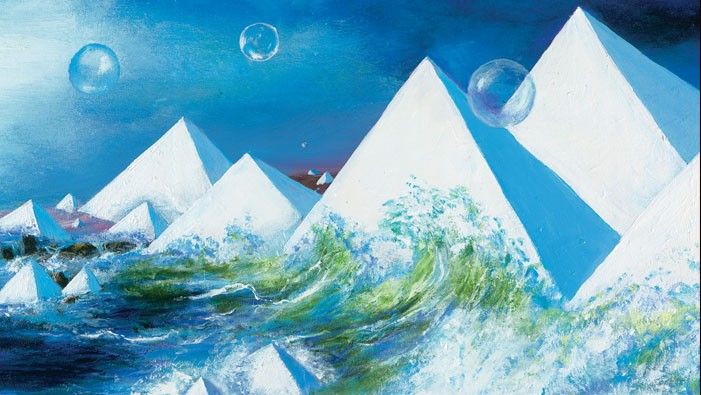
Akiane Kramarik had a dream about this vision and painted it:

“…In one of my dreams I saw the image of white pyramids beaten by the ocean waves and surrounded by LIVE bubbles. Unlike most of my paintings, I had no idea what those symbols meant, but I painted them anyway. Today the meaning still remains a riddle…”

– Akiane

It is just another confirmation for me that God is real. I know what the symbols mean because God revealed their meaning to me several years ago when I began studying His Word in depth. I have blogged about the symbols in my blog here in my posts about Circles and 22/7.

Recently I traveled home and was confronted with some truths which were hard for me, yet healing. In the midst of this, I stumbled upon Akiane’s painting above (I already was a fan of hers from years ago), and it was an awesome discovery because I felt God saying to me,
“Your thoughts about me are real, and I am real. You can put your trust in Me.”
It was like a multi-dimensional hug from God made specifically for me because I am aware of the meaning of this painting.
The water is all around us, all life; the lower waters and upper waters encompass all life. Our Universe was created from the waters. Life is born from water. But to be born unto the spiritual realm, God’s realm, we must all be born again of the Spirit.
The pyramids were made because the Egyptians knew the secret of pi, 22/7, the circle, from which all other geometric shapes are born. They used pi as the foundation for making the great pyramids and the Babylonians used a slightly different version of pi, 25/8 to make their ziggurats and other structures. Throughout the Bible, 22/7 is infused into the narrative if you know how to look for it. The circle means God. That is why ancient man made giant stone circle rings out of rocks that can only be viewed from the sky. It was a message to God and a way to honor Him, and I believe, a way to show they were waiting for their Messiah.
The bubbles in the painting represent how the living water, Jesus Christ, merges with the circle of God, becoming one. The water overlapping the pyramids means the water which encompasses us all can destroy even our greatest creations, even if we know the secret of pi and the secrets of God. Only by being born again unto Jesus Christ and becoming part of the Living Water, and becoming like children in our love and joy, can we overcome the inevitable destruction to come, the second death. And rise up into Heaven above.
~selah

Commitment to Man

But Jesus did not commit Himself to them, because He knew all men, and had no need that anyone should testify of man, for He knew what was in man.  ~John 2:24-25

This is exactly how I feel increasingly of late.  Yet if I say it out loud, people would call me a ‘jaded’ or ’embittered’ woman.  I see how men consistently are, and I am reticent to commit myself to any of them because most men I meet and know are of the world, even if they profess to be Christians.  Men unanimously exude the traits of selfishness and lust, and often thanklessness, way too often for me to want to be involved with them.  Combine that with their natural proclivity to be prideful (a typical male characteristic), and, well, you have a recipe for being ensnared in your life.

I am beginning to come on board with Paul’s line of thinking that if you are single, it is best to stay single in order to fulfill God’s will as much as possible.  It is nigh on impossible to find a male worthy of a Godly woman, and I propose that it is getting harder as time goes by and more and more people fall away from the church.

It gives me comfort to know Jesus felt the same way about men.  I feel validated.  The world may call me jaded, but I will accept that because I would rather be jaded with Jesus, than foolish with men.


Posers

Among the many who profess the Christian faith, scarcely one in a thousand reveals any passionate thirst for God.  ~A.W. Tozer

A W Tozer.jpg

Elijah Taken Up in a Tempest

I have heard of people being taken up into the heart of a tornado and carried away, so when I read again that Elijah was carried up in a tempest, the thought occurred to me that this was what happened to Elijah.  It seems everyone around knew that Elijah was going to be taken that day, as recounted in the famous Bible story of 2 Kings 2.

The Hebrew word for tempest is C’RH or C’arah, which means ‘hurricane’ or ‘whirlwind’.  Could it be that Elijah was a storm-chaser?  Elijah in the recent past had begged God ‘for his life, to die’.  I believe God wanted to make Elijah’s exit from this world an extraordinary one and led him into the heart of a divine storm for that very reason.  Tornadoes rarely occur inland in Israel.

A while before this, Queen Jezebel threatened Elijah’s life for killing her prophets of Baal, and distraught, he fled to Beer-sheba which means ‘well of the oath’, the Hebrew ‘shaba’ meaning ‘to be complete’ or ‘to seven oneself’, which is also the root word for the Sabbath, or Shabbat, the day God rested from His work.  He parted with his ‘young man’ there and went alone a day’s journey into the Wilderness, and came and sat under a ‘certain broom tree’.  It is likely this was a huge and remarkable tree which was also enjoyed by Abraham, Isaac, or Jacob.  It might even have been the tree where God revealed the initial promise to Abraham.  Broom tree in Hebrew is RTHM, rothem, and it means ‘to bind’.  The Juniper tree below is a likely candidate for Elijah’s broom tree.

Juniper or ‘broom’ tree

Here Elijah begged for his life, but not in the way we usually think of as in to save his life.  Elijah begged for YHWH, Yahweh, to take his life, that he might die, because, he said, “Enough now, Yahweh, take my life, for I am no better than my fathers.”  Enough in Hebrew is RB, Rab, and it means ‘abundant’.  This tells us Elijah felt his life had been abundant.  Then he slept and an angel ministered to him two times to give him strength for his journey, because he still had much to do before he could die.

He then journeyed in the vigor of that food for 40 days and 40 nights (the Biblical right of passage) until he came to the Mount of God, Mount Horeb, where Moses received the 10 Commandments and the Hebrew people became a nation.  He lodged there in a cave and God entreated him twice to tell him why he was there.  Both times Elijah iterated that he was the only prophet left alive and that they sought to take his life, that he had done his duty by Yahweh, and that he was alone.  Surely Elijah knew his death was inevitable and he did not want to die by the hand of evil ones.  So God, granting his plea, sent Elijah back by way of the Wilderness to Damascus to fulfill three tasks, the last of which was to anoint Elisha as prophet to take his place. (1 Kings 19)

Then a bit later in 2 Kings 2, Elijah and Elisha venture forth from Gilgal via Bethel, Jericho, and finally cross the Jordan River.  This is when Elijah was separated from Elisha by a chariot of fire, and horses of fire, and taken up into a tempest, never to be seen again.

This is a journey of 22 miles:

-Gilgal 7 miles north of Bethel (this is not the Gilgal of Joshua near the Jordan, but the mountainous Gilgal

-Bethel to Jericho is approximately 10 miles (by guestimation)

-Jericho to the Jordan is about 5 miles

Walking a mile in 30 minutes means that it took at least 11 hours for Elijah and Elisha to get from Gilgal to the Jordan River, probably more because of descending the mountain of Gilgal and navigating Bethel.

This linked study does a remarkable job at looking into the meaning behind the name of the different cities and town the prophet and his student journeyed through:  The Journey of Elijah and Elisha and its Meaning .

The Journey of Elijah and Elisha Before Elijah was Taken Up
The only additions I feel necessary to make to the above referenced Bible study is that Elijah ‘took up his mantle’ and divided the waters and they parted in two.  Just like Moses had lifted his staff to divide the waters of the Red Sea in two.  To me this is a reference to God being two parts, ALHYM and Yahweh, Father and Son.  Perhaps three, if we consider the Holy Spirit is the one doing the dividing.  This is a clear reference to Messiah, because Messiah is the living water everyone was awaiting.  And God in Heaven separates the waters which encompasses all of life, known and unknown.

But why does Elijah go back across the Jordan to the wrong side to be taken up?  I believe it is because Elijah never really lived in the Promised Land, but was always a prophet outcast whom rulers sought the life of.  Like Moses, Elijah was unable to really access the Holy Land given to God’s people, though he lived there all of this days, being like Jesus ‘not of this world’.  Elijah’s name in Hebrew means “my God is Yahweh”, Yahweh being our word for Jesus.  Elijah died before seeing the Messiah come and therefore was not able to be taken up into Heaven from the Holy Land, but first had to cross back over the Jordan to near the same place Moses himself died.


The Joy of the LORD

…is like effervescence on a glass of champagne

it is being lifted up above it all

all the cares of this world

are left behind

and all that

remains is

Joy!

Part 1. Matter and Antimatter: Lower and Upper Waters, Day and Night

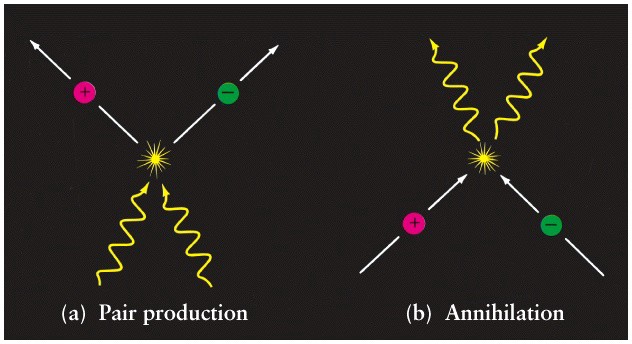
It fascinates me how when matter and antimatter collide it produces photons or gamma rays, which is pure light.  This physical process is called ‘annihilation’, and a lot of energy is released when it happens.  Light can also be separated in a process called ‘pair production’, though we humans cannot do that very well yet.

But God can.  God is Pure Light.  This means He doesn’t exist in a momentary flash of light like particles do when they meet their oppositely charged partner.  He holds this process in Himself eternally, making Him perpetual LIGHT. (see GIF in this link).  In His miraculous way he keeps the flow of positive and negative energy colliding where He is.  Despite our efforts, we have not been able to harness enough antimatter to boil a cup of tea (http://www.symmetrymagazine.org/article/april-2015/ten-things-you-might-not-know-about-antimatter.)

We are created in His image, therefore we are created from this Light Source.  And we become matter while our other side is held apart from us somewhere, because to meet with our particular antimatter would mean we become annihilated, to use the proper scientific term.

I believe the mystery of the Upper Waters which are created on the Second Day of creation are where God stores the antimatter, and perhaps the dark energy too, which make up most of our universe.  He separates ‘the waters from the waters’ which is a confusing statement until you consider it sounds almost completely similar to matter and antimatter!  Heaven-the Expanse-separates Light from Darkness because for us there would be nothing if there were no Expanse:  what makes us, and everything around us, would find its mate and annihilate into pure Light, then disappear.

Evil exists everywhere.  Satan wants to speed this process of annihilation along because he wants to create light himself.  He wants control over death, and he is bent on killing and destroying everything.  Does he not realize he cannot create perpetual light which is God?  No, he does not.  Most of those intent on evil are extremely myopic in their vision, if you think about it.  They cannot see the big picture, but only the part of the picture where they place themselves as king for a moment.  And satan is no different.

Man too would like to control life.  Which is ultimately why we are seeking antimatter.  Once we understand it we can control it and use it.  But what man does not see in his own myopia is that God in Heaven stands firmly between the two.  And with a Word can control our destiny in a flash, like He did with the Big Bang.

Illustration:

Genesis 1:  King James Version

In the beginning God created the heaven and the earth.

And the earth was without form, and void; and darkness was upon the face of the deep. And the Spirit of God moved upon the face of the waters. [b below]

3 And God said, Let there be light: and there was light.  [b below]

(b) represents the waters (+) and (-) coming together at God’s command to create light, also called ‘annihilation’.  “Whoever loses his life for my sake shall find it.”  ~Jesus

And God saw the light, that it was good: and God divided the light from the darkness [a below].

And God called the light Day, and the darkness he called Night. And the evening and the morning were the first day.  [a below]

(a) represents God dividing the light from the darkness.  And He called the light Day [matter] and the darkness Night [dark, or anti-, matter].  And this completed the First Day.  This is called ‘pair production’.  As I discuss in my Exegesis of Genesis the light and darkness here is more figurative than literal when one looks at the original words in Hebrew, and since our luminaries (the sun, moon, and stars) will not actually be formed until the Fourth Day. 

And God said, Let there be a firmament in the midst of the waters, and let it divide the waters from the waters.

Dividing the waters from the waters means dividing the matter from the antimatter, because if they do not stay divided they will annihilate (see video below).  God creates the expanse-Heaven-to separate these two opposing forces.  He is the gate-keeper between life and death not just for individuals but for all matter.

And God made the firmament, and divided the waters which were under the firmament from the waters which were above the firmament: and it was so.

And God called the firmament Heaven. And the evening and the morning were the second day.

And God said, Let the waters under the heaven be gathered together unto one place, and let the dry land appear: and it was so.

And the upper waters are not referred to again except in Psalm 148:4:  “Praise him, ye heavens of heavens, and ye waters that be above the heavens.”

10 And God called the dry land Earth; and the gathering together of the waters called he Seas: and God saw that it was good….