
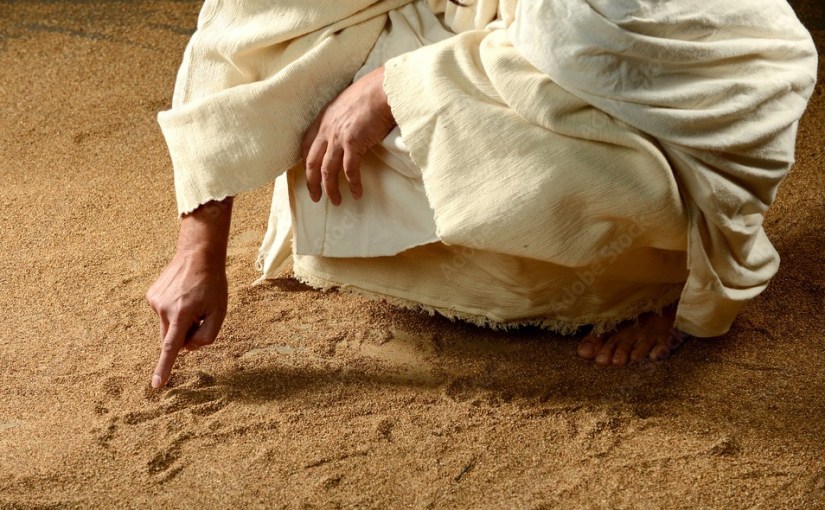
I was doing a bible study on parables today and the story about the woman caught in adultery was called to mind, where Jesus wrote something mysterious in the sand. And He famously said, “He who is without sin, let him cast the first stone”. Ahh, so classic. As the instructor was mentioning it briefly, God flashed to me the illustration of the hand writing on the wall in the king’s palace in the book of Daniel. The similarity of this parable and the story in Daniel of the writing on the wall are so obvious once you think about it! Upon further deduction, I do think Jesus was writing the same Aramaic phrase in the earth that the hand was writing on the wall:
Mene Mene Tekel Pharsin
This phrase means God has numbered you and you are finished (Mene). You have been weighed in the balances and found lacking (Tekel). Your people are divided and will be conquered (Pharsin). This phrase would definitely have rung true also in Jesus’ time since the Jewish nation was oppressed by the Romans, and there was constant threat of persecution and crucifixion. Death was pervasive. The Sanhedrin were always afraid of upsetting the Roman apple cart and being unable to practice their religion in Israel.
If this was what Jesus inscribed in the dirt, what would have affected the scribes and pharisees more was Jesus’ reference to the book of Daniel where this phrase made its debut. Jesus was schooling them as the voice of God. I suggest that they were so shocked by Him and His use of these words that they slowly, one by one, were convicted and dumbstruck, and walked away silently. It was noted elsewhere in the New Testament writings that Jesus drew on Old Testament prophets and writings to show his divinity and purpose. The Pharisees and Sadducees were always becoming stymied and speechless by Him. So it makes total sense that he was doing the same thing in this depiction.
Jesus said to the woman, “I don’t judge you. Go and sin no more”. The irony is that in true Jesus fashion, He took the judgment the men intended for the woman and turned it back on the men! They received judgment while she was forgiven and renewed.
There are some striking similarities between the two stories about mysterious writing that make me convinced this was the import of Jesus’ writing.
The Writing on the Wall
Belshazzar, the son of Nebuchadnezzar, was king of Babylon and decided to have a party for a thousand of his nobles. They brought out the golden vessels taken from the house of the Lord in Israel and used them to toast to many gods. At that moment finger of a man’s hand came out and wrote on the plaster of the wall of the king’s palace across from the lampstand. And the king saw the part of the hand that wrote. Then the king’s color was changed, and his thoughts troubled him, so that he was trembling mightily and sent to find someone who could read this writing and reveal its meaning. The one who could tell the king its meaning would be clothed in purple, given a chain of gold around his neck, and shall rule 3rd in the kingdom. That night King Belshazzar was killed. ~Daniel 5:1-7
The Parable of the Woman Caught in Adultery
As Jesus was teaching in the temple at dawn, the scribes and pharisees brought to Him a woman having been taken in adultery. They said, Teacher, in the Law Moses commanded that such should be stoned. You, then, what do you say? They said this to tempt Him in order to accuse Him. But bending down, Jesus wrote with the finger in the earth, not appearing to hear. He then stood up and said, “The one among you without sin, let him cast the first stone at her.” And bending down again, He wrote in the earth. But hearing, and being convicted by the conscience, they went out one by one, beginning from the older ones, until the last. And Jesus was left alone, and the woman standing there. And Jesus stood back up, and observing no one but the woman, He said to her, “Woman, where are your accusers? Did not one give judgment against you?” And she said, “No one, Lord.” And Jesus said to her, “Neither do I give judgment. Go, and sin no more.” ~John 8:1-11
Similarities
- Finger There are really no other stories I can think of in the bible where fingers of a hand write something that strikes fear into men. I think it’s too coincidental that Jesus wrote with a finger in the earth of the temple yard, and that fingers of a man’s hand wrote on the plaster of the wall of the king’s palace.
The Hebrew word “etsba” primarily refers to a “finger.” It is used in the Bible to denote the physical finger of a person or, metaphorically, to describe the work or action of God. The term can also imply precision, skill, or the act of pointing. Cultural and Historical Background: In ancient Hebrew culture, the finger was often symbolic of power and action. The use of fingers in gestures, such as pointing or writing, was significant in communication and expression. The finger of God, as mentioned in the Bible, signifies divine intervention or the execution of God’s will with precision and authority.
- Mysterious The writing on the wall was written in a language unknown by King Belshazzar, but known to the Hebrew people, and Daniel. The writing in the earth is a mystery to everyone but the Jews who were present. I doubt even the woman knew what was written since women were mostly illiterate in those times.
- Judgment Both writings proclaimed some judgment upon man. In Daniel, it was because of the sin of idolatry; and in John, it was because of the hypocritical mindset of the Pharisees and scribes. Jesus was showing that the law is something that is written in our hearts versus something to be used to hurt people.
- 3rd Highest The other compelling symbolism I found tying these two narratives together is that the person who revealed the writing’s meaning in Daniel would receive a purple robe, golden necklace, and rule third in the kingdom. This all implies kingship and authority. Jesus knew this when he wrote MENE MENE TEKEL PHARSIN in the sand. We know his meaning was understood when the Jewish leaders quietly walked away. I am sure few understand the full import of His meaning, that He understood His place as the 3rd in the Holy Trinity: Father, Holy Spirit, and Son.
- Holy Bread The most exciting discovery for me to glean from these two texts is that hidden meaning you have to dig to find. It is in the comment regarding the location of the writing in the palace: “on the wall across from the lampstand”. In the tabernacle and later in the temple, there were explicit locations for the items that were used by the priests outside the Holy of Holies (where the ark of the covenant and the 10 Commandments were kept). Some of these pieces of furniture were the alter, the table of incense, and the lampstand. But across from the lampstand was located the table of shewbread. Jesus is symbolic of the showbread! The showbread was a constant reminder of God’s covenant with his people and his provision for the 12 tribes of Israel, represented by the 12 loaves. Jesus is the true Bread of Life, giving unfailing sustenance to all who partake of Him. Light from the golden lampstand illuminated the table of showbread causing it to sparkle with a dazzling beauty as the small ornately tooled table stood stately on the right side of the holy place.
I am the living bread which came down from heaven: If any man eat of this bread, he shall live forever; and the bread that I will give is my flesh, which I will give for the life of the world. ~John 6:51
Jesus is always teaching us that He is the completion of the law; He is the New Covenant. In this story He is the writing on the wall, He is the bread of life, and He is the one who has been given the authority to judge men.
 ~Song of Mary~
One thought on “Part 1: The Finger of God: The Writing in the Sand and the Writing on the Wall”