
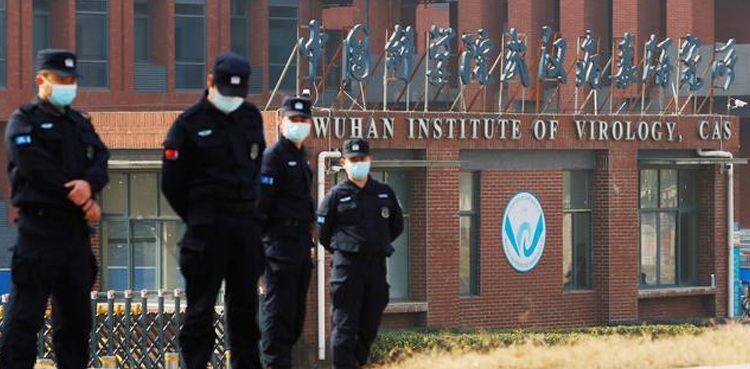
Wikipedia: Biosafety level 4 laboratories are used for diagnostic work and research on easily transmitted pathogens which can cause fatal disease. At present, more than 50
maximum- and high-containment facilities around the globe handle some of the world’s most hazardous pathogens to human and animal health for research and diagnostic purposes. Only 1 BSL-4 lab is in China–in Wuhan.
The Wuhan National Biosafety Laboratory is about 20 miles from the city centre seafood market, where the coronavirus is thought to have originated.
62 years ago:
The predecessor of Wuhan Institute of Virology, Chinese Academy of Sciences was the Wuhan Institute of Microbiology, prepared to be built in 1956, jointly established by the famous virologist academician Gao Shangyin and the famous microbiologist academician Chen Huagui and a batch of older generation scientists, formally announced to be established in 1958, mainly engaged in agricultural virus and environmental microbe research.
25 to 35 years ago:
In the 1980s and 1990s, the Wuhan Institute of Virology has made a series of important progresses in terms of insect virus, animal virus, molecular virus, virus classification preservation, environmental microbes, fermentation microorganisms and microbial sensors.
Bedford’s analyses of RaTG13 and 2019-nCoV suggest that the two viruses shared a common ancestor 25 to 65 years ago, an estimate he arrived at by combining the difference in nucleotides between the viruses with the presumed rates of mutation in other coronaviruses. So it likely took decades for RaTG13-like viruses to mutate into 2019-nCoV.
“One of the biggest takeaway messages [from the viral sequences] is that there was a single introduction into humans and then human-to-human spread,”
Concerns about the institute predate this outbreak. Nature ran a story in 2017 about it building a new biosafety level 4 lab and included molecular biologist Richard Ebright of Rutgers University, Piscataway, expressing concerns about accidental infections, which he noted repeatedly happened with lab workers handling SARS in Beijing. Ebright, who has a long history of raising red flags about studies with dangerous pathogens, also in 2015 criticized an experiment in which modifications were made to a SARS-like virus circulating in Chinese bats to see whether it had the potential to cause disease in humans. Earlier this week, Ebright questioned the accuracy of Bedford’s calculation that there are at least 25 years of evolutionary distance between RaTG13—the virus held in the Wuhan virology institute—and 2019-nCoV, arguing that the mutation rate may have been different as it passed through different hosts before humans. Ebright tells ScienceInsider that the 2019-nCoV data are “consistent with entry into the human population as either a natural accident or a laboratory accident.”
Source: https://www.sciencemag.org/news/2020/01/mining-coronavirus-genomes-clues-outbreak-s-origins
 ~Song of Mary~