
I have heard of people being taken up into the heart of a tornado and carried away, so when I read again that Elijah was carried up in a tempest, the thought occurred to me that this was what happened to Elijah. It seems everyone around knew that Elijah was going to be taken that day, as recounted in the famous Bible story of 2 Kings 2.
The Hebrew word for tempest is C’RH or C’arah, which means ‘hurricane’ or ‘whirlwind’. Could it be that Elijah was a storm-chaser? Elijah in the recent past had begged God ‘for his life, to die’. I believe God wanted to make Elijah’s exit from this world an extraordinary one and led him into the heart of a divine storm for that very reason. Tornadoes rarely occur inland in Israel.
A while before this, Queen Jezebel threatened Elijah’s life for killing her prophets of Baal, and distraught, he fled to Beer-sheba which means ‘well of the oath’, the Hebrew ‘shaba’ meaning ‘to be complete’ or ‘to seven oneself’, which is also the root word for the Sabbath, or Shabbat, the day God rested from His work. He parted with his ‘young man’ there and went alone a day’s journey into the Wilderness, and came and sat under a ‘certain broom tree’. It is likely this was a huge and remarkable tree which was also enjoyed by Abraham, Isaac, or Jacob. It might even have been the tree where God revealed the initial promise to Abraham. Broom tree in Hebrew is RTHM, rothem, and it means ‘to bind’. The Juniper tree below is a likely candidate for Elijah’s broom tree.

Juniper or ‘broom’ tree
Here Elijah begged for his life, but not in the way we usually think of as in to save his life. Elijah begged for YHWH, Yahweh, to take his life, that he might die, because, he said, “Enough now, Yahweh, take my life, for I am no better than my fathers.” Enough in Hebrew is RB, Rab, and it means ‘abundant’. This tells us Elijah felt his life had been abundant. Then he slept and an angel ministered to him two times to give him strength for his journey, because he still had much to do before he could die.
He then journeyed in the vigor of that food for 40 days and 40 nights (the Biblical right of passage) until he came to the Mount of God, Mount Horeb, where Moses received the 10 Commandments and the Hebrew people became a nation. He lodged there in a cave and God entreated him twice to tell him why he was there. Both times Elijah iterated that he was the only prophet left alive and that they sought to take his life, that he had done his duty by Yahweh, and that he was alone. Surely Elijah knew his death was inevitable and he did not want to die by the hand of evil ones. So God, granting his plea, sent Elijah back by way of the Wilderness to Damascus to fulfill three tasks, the last of which was to anoint Elisha as prophet to take his place. (1 Kings 19)
Then a bit later in 2 Kings 2, Elijah and Elisha venture forth from Gilgal via Bethel, Jericho, and finally cross the Jordan River. This is when Elijah was separated from Elisha by a chariot of fire, and horses of fire, and taken up into a tempest, never to be seen again.
This is a journey of 22 miles:
-Gilgal 7 miles north of Bethel (this is not the Gilgal of Joshua near the Jordan, but the mountainous Gilgal
-Bethel to Jericho is approximately 10 miles (by guestimation)
-Jericho to the Jordan is about 5 miles
Walking a mile in 30 minutes means that it took at least 11 hours for Elijah and Elisha to get from Gilgal to the Jordan River, probably more because of descending the mountain of Gilgal and navigating Bethel.
This linked study does a remarkable job at looking into the meaning behind the name of the different cities and town the prophet and his student journeyed through: The Journey of Elijah and Elisha and its Meaning .
 The Journey of Elijah and Elisha Before Elijah was Taken Up
The only additions I feel necessary to make to the above referenced Bible study is that Elijah ‘took up his mantle’ and divided the waters and they parted in two. Just like Moses had lifted his staff to divide the waters of the Red Sea in two. To me this is a reference to God being two parts, ALHYM and Yahweh, Father and Son. Perhaps three, if we consider the Holy Spirit is the one doing the dividing. This is a clear reference to Messiah, because Messiah is the living water everyone was awaiting. And God in Heaven separates the waters which encompasses all of life, known and unknown.
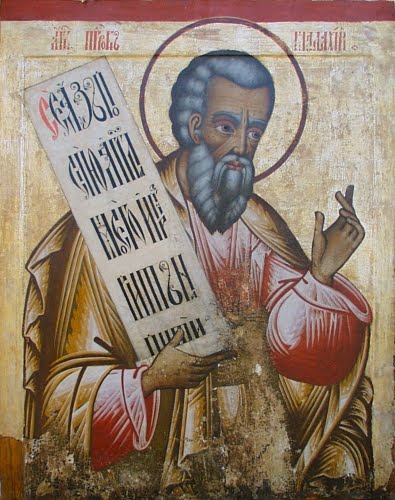
But why does Elijah go back across the Jordan to the wrong side to be taken up? I believe it is because Elijah never really lived in the Promised Land, but was always a prophet outcast whom rulers sought the life of. Like Moses, Elijah was unable to really access the Holy Land given to God’s people, though he lived there all of this days, being like Jesus ‘not of this world’. Elijah’s name in Hebrew means “my God is Yahweh”, Yahweh being our word for Jesus. Elijah died before seeing the Messiah come and therefore was not able to be taken up into Heaven from the Holy Land, but first had to cross back over the Jordan to near the same place Moses himself died.
 ~Song of Mary~