
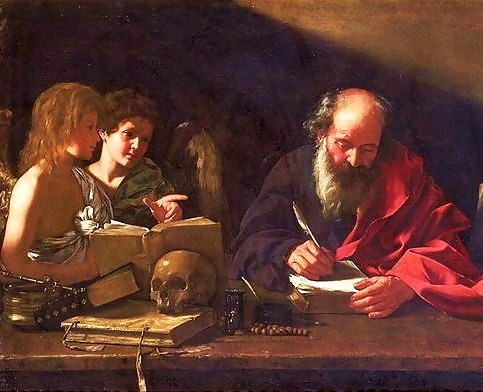
I’m not there yet, but I feel myself heading there rather quickly now. I’m not sure how much seclusion I will undergo, but I definitely feel called to seclude myself more and more. I believe that I should not seek out interactions now, and that I am called to be chaste with my speech, live minimally with the goal being only what I can carry, and to be obedient to God every moment of every day. Although I will focus on isolation, I should lovingly welcome interactions that God sends me, as an anchoress would if someone sought out her advice or listening ear.
They usually live by the three evangelical counsels or counsels of perfection in Christianity are chastity, poverty (or perfect charity), andobedience.[1] As Jesus of Nazareth stated in the Canonical gospels,[2] they are counsels for those who desire to become “perfect” (τελειος, cf. Matthew 19:21, see also Strong’s G5046 and Imitatio dei). The Catholic Church interprets this to mean that they are not binding upon all and hence not necessary conditions to attain eternal life (heaven). Rather they are “acts of supererogation” that exceed the minimum stipulated in the Commandments in the Bible.[3] Christians that have made a public profession to order their life by the evangelical counsels, and confirmed this by a public religious vow before their competent church authority (the act of religious commitment called “profession”), are recognised as members of the consecrated life.
-
- The Eremitic Life
- Without always professing the three evangelical counsels publicly, hermits “devote their life to the praise of God and salvation of the world through a stricter separation from the world, the silence of solitude and assiduous prayer and penance”. (Footnote: CIC, can. 603 §1)
-
- They manifest to everyone the interior aspect of the mystery of the Church, that is, personal intimacy with Christ. Hidden from the eyes of men, the life of the hermit is a silent preaching of the Lord, to whom he has surrendered his life simply because he is everything to him. Here is a particular call to find in the desert, in the thick of spiritual battle, the glory of the Crucified One.
Here is a description of solitary life serving God:
What is a Solitary?
Solitaries are those who are called to or have chosen solitude as a way of life. The Solitaries of Saint Benedicts are hermits, semi-hermits, and hermits-in-the-world. The following is an explanation of these three terms as understood by the Solitaries.
A hermit is a person who lives alone, withdrawn from society. A hermit is not a recluse, and so a hermit can entertain visitors, go on journeys, and otherwise interact with others. A hermit usually lives at some physical separation from other people to make a life of solitude easier. A hermit’s dwelling is known as a hermitage, although a group of hermits living together are often referred to as a skete.
A semi-hermit is a person who lives with others but cultivates an interior silence and solitude with some physical barriers. The most famous semi-hermits are the Carthusians, nuns and monks who live in a Charterhouse, a cluster of hermitages where each monastic lives and works alone, leaving only a three times a day for communal worship in the monastery church. Most of the Solitaries of Saint Benedict are semi-hermits, as many of them live as members of families or other forms of residential community.
A hermit-in-the-world is a kind of urban hermit who lives alone but with minimal physical separation from society. These hermits were common in the Medieval period, when they were known as anchorites or anchoresses and lived in “anchorholds.”
What is the difference between a hermit and a recluse?
As stated above, a hermit has contact with the outside world. A recluse is a person who has completely retreated from the world with only very rare and occasional contact with others. The Solitaries of Saint Benedict do not envision reclusion as part of the life of a Solitary, but a Solitary may decide upon reclusion in consultation with the Prior.
~taken from: https://solitariesofsaintbenedict.wordpress.com/what-is-a-solitary/
The solitary life is seen as being lived within the fellowship of the Body of Christ, in which the solitary has an honoured place going back to St Antony of Egypt and the other Fathers and Mothers of the Egyptian desert. In these islands this kind of life is represented by Celtic monks like Columba, Aidan and Chad. In the Middle Ages there were countless anchorites and hermits scattered throughout Britain, of whom Julian of Norwich and Richard Rolle of Hampole are perhaps the best known. It was a commonplace then that many people, feeling a call to solitude, would go and live on the edge of their village in much the same way as Antony of Egypt did when he began. Such people supported themselves by their work, as the earliest monks did. Often such work involved public service such as repairing roads and bridges. They were accepted as those who were called to a life of prayer. Work and prayer have always gone hand in hand.
The degree of solitude and of involvement in the life of the local Christian community is something which each has to decide in the light of circumstances and at the prompting of the Holy Spirit. The solitary’s prayer needs to be nourished by regular spiritual reading, in which Holy Scripture, the Psalms, and the writings and lives of the Desert Fathers and Mothers and others in the monastic tradition should find their place. There are also many modern books on prayer and the spiritual life which can be read with profit.
The solitary life is essentially hidden; there is no badge or habit, no special title, nothing to suggest a corporate identity. The Fellowship has none – it is not a community or a society, just a fellowship of people each pursuing his or her own path but banded together for support and encouragement. Our witness is the way we live, and is thus a prophetic sign in its solitude, simple unobtrusiveness and silence. The medieval anchoress had one window into the church, but another looking out on to the world, which she could close with a curtain when “not at home”, but at which people could consult her. We find this too – God sends people to us and we must welcome them in God’s name.
Because the life is solitary, it is personal to each; no two follow the same path. For that reason the Fellowship has no rule of life; it is most unlikely that it ever will. How we can pray best is for each to discover for her- or himself. All that is asked of members is that they pray for each other, and for all others living the solitary life, and that they pay the modest subscription that enables the Newsletter, issued three times a year, to be produced and distributed. Members are encouraged to contribute items to the Newsletter so that we may profit by sharing each other’s experience of the solitary life.
PATHS IN SOLITUDE
Eve Baker
Solitude and silence are hard to find in the modern world, which regards both as aberrations which must be avoided. Yet solitude has never been more sought after, as the growth of the retreat movement shows. Increasingly, people are experiencing an interior call to solitude which, although it was a commonplace in the Middle Ages, is strange to today’s religious concerns, with their emphasis on community. The solitary, standing outside these concerns, witnesses to a God who is divinely other and not a commodity to be possessed by the world for its own ends.
The mystery of God is encountered in silence and solitude. The creative artists make raids into this unknown world of mystery, and return bearing artefacts. Others make solitude their home; these are the contemplatives. This book examines firstly various aspects of solitude: solitude and society, the artist as solitary, and physical solitude. Part II looks at the historical roots of the solitary life, the monastic path, travellers and wanderers, hermits and institutions. The final part is a guide to the Christian solitary life, the practicalities and the prayer of the solitary.
Published by: St Pauls Price £5.95 ISBN 085439 513 x
Can be ordered in UK from all good booksellers, including St Pauls Bookshop, near Westminster Cathedral.
Available online from amazon.co.uk
~all previous quote taken from: http://www.solitaries.org.uk/index.html
 ~Song of Mary~